A post submitted by CGI member ScienceTruth.
************************
The Winnemucca Institute for Advanced Studies Presents:
Electricity in Space ! Part II #8. The Comparative Spectrum Series
It is extremely important to use multiple 'octaves' of the ElectroMagnetic Spectrum in our observations of various objects in Space. Octaves such as; radio, microwave, infrared, visible, ultraviolet, x-ray, gamma ray, and at times highly-specific wavelengths, like 21cm hydrogen-alpha, which is the wavelength hydrogen will emit in, when 'energized'.
Each 'octave' of the EM Spectrum has its own special set of data / or story / or tale to tell ! And to get the 'complete picture' of "what's happening" at each object we observe, we really need to give our attention to all of the octaves in the EM Spectrum !!
By studying these different 'areas' of the energy spectrum, different activities are 'brought to light' !!, thusly helping us to better understand the "total goings on" at whatever is the object of our study.
As previous in this Series have looked at PNe and SGZ's, let's look at something new !! Like the Center of our Galaxy !! and do so in several 'octaves' or 'areas' or 'ranges' of the EM Spectrum.
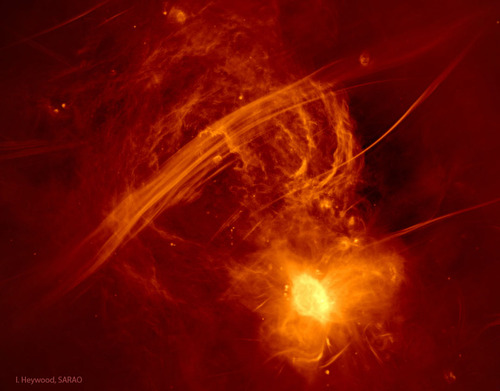
The Galactic Center Radio Arc
Image Credit: Ian Heywood (Oxford U.), SARAO
https://apod.nasa.gov/apod/ap230403.html
Explanation: What causes these unusual gently curving structures near the center of our Galaxy ? The long parallel rays slanting across the upper left of this featured image are in the radio wavelength spectrum, and are known collectively as the Galactic Center Radio Arc.
The Radio Arc is connected to the Galactic Center by additional orthogonally curving filaments known as The Arches. The bright radio structure, at the bottom right, surrounds the active Galactic Center which is known as Sagittarius A.
The best hypothesis for the origin of the Radio Arc and the Arches, and their orthogonal geometry, is that there is a 'current of electric energy' flowing thru the Central Region of our Galaxy, and this electric current causes a magnetic field to manifest, and hot plasma is attracted to "the lines of magnetic field strength" in the magnetic field, and these plasmas are 'glowing' in the radio spectrum !
More work and study definitely needs to be done on all of these 'goings on' at the Center of our Galaxy !
Unfortunately, our Galactic Center is about 25,000 light years away ! and in the Visible Light wavelengths it is completely obscured by dust and other 'stuff ' between us and the Galactic Center, which is a good argument for studying PNe and SGZ's !
- -
Galactic Central Region
The Galactic Center in Radio from MeerKAT
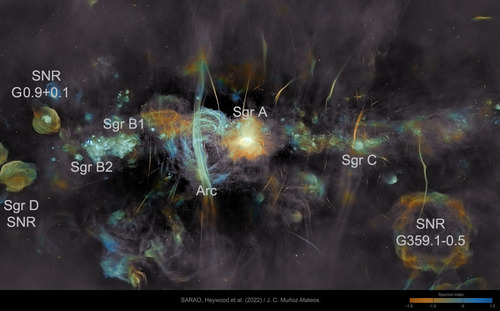
Image Credit: Ian Heywood (Oxford U.), SARAO; Color Processing: Juan Carlos Munoz-Mateos (ESO)
https://apod.nasa.gov/apod/ap220202.html
Explanation: What's happening at the center of our galaxy ? It's hard to tell with optical telescopes since visible light is blocked by intervening interstellar dust. In other bands of light, though, such as radio, the galactic center can be imaged and shows itself to be quite an interesting and active place. The featured picture shows the latest image of our Milky Way's center by the MeerKAT array of 64 radio dishes in South Africa. Spanning four times the angular size of the Moon (2 degrees), this image is impressively vast, deep, and detailed. Many known sources are shown in clear detail, including many with a prefix of Sgr, since the galactic center is in the direction of the constellation Sagittarius. In our Galaxy's Center lies Sgr A, found here in the image center, which houses the Milky Way's central supermassive Z-Pinch. Other sources in the image are not as well understood, including the Radio Arc, just to the left of Sgr A, and the numerous filamentary threads of The Arches. Goals for MeerKAT include searching for radio emission from neutral hydrogen emitted in a much younger universe and brief but distant radio flashes.
- -
The Galactic Center from Radio to X-ray
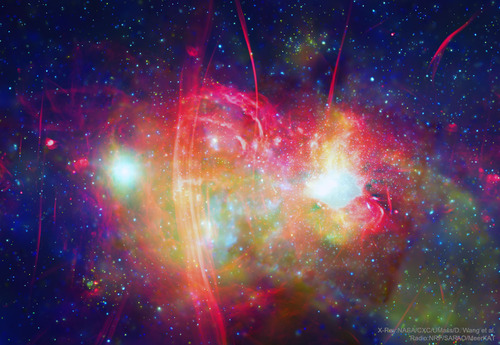
Image Credit: X-Ray: NASA Chandra, CXC, UMass, D. Wang et al.; Radio: NRF, SARAO, MeerKAT
https://apod.nasa.gov/apod/ap200331.html
Explanation: In how many ways does the center of our Galaxy glow ? This enigmatic region, about 26,000 light years away toward the constellation of the Archer (Sagittarius), glows in every type of light that we can see. In the featured image, high-energy X-ray emission captured by NASA's orbiting Chandra X-Ray Observatory appears in green and blue, while low-energy radio emission captured by SARAO's ground-based MeerKAT telescope array is colored red. Just on the right of the colorful central region lies Sagittarius A (Sag A), a strong radio source that coincides with Sag A*, our Galaxy's central supermassive black hole [no, it's a Z-Pinch]. Hot gas [plasma] surrounds Sag A, as well as a series of parallel radio filaments known as the Radio Arc, seen just left of the image center. Numerous unusual single radio filaments are visible around the image. Many stars orbit in and around Sag A, as well as numerous small black holes [wtf ?] and dense stellar cores known as neutron stars [another 'fictitious entity' due to mathematical 'errors'] and white dwarf stars. The Milky Way's central supermassive black hole* is currently being imaged by the Event Horizon Telescope*. [ *more BS from the Mainstream, or Science Lies as I call them. Malarkey specifically designed to extract funding for fictitious equipment and experiments that have fraudulent results published to extract more funding, like LIGO and LISA.]
- -
As an extra, in multiple wavelengths, is the most excellent 'reprocessed data' image of eta Carinae, as done by Judy Schmidt !!!
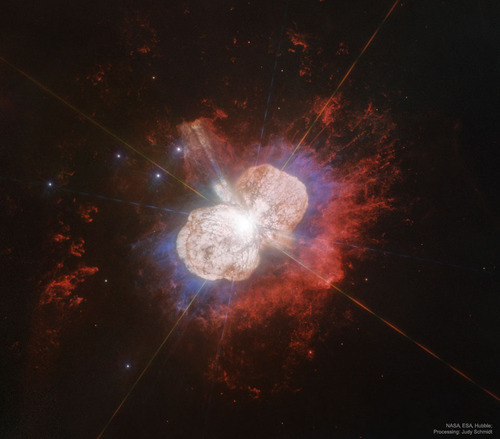
Star Eta Carinae
Image Credit & Copyright: NASA, ESA, Hubble; Processing & License: Judy Schmidt
https://apod.nasa.gov/apod/ap230709.html
Explanation: Eta Carinae may be about to explode. But no one knows when - it may be next year, it may be one million years from now. Eta Carinae's mass - estimated at about 100 times greater than our Sun - makes it an excellent candidate for a full blown supernova. Historical records do show that about 170 years ago Eta Carinae underwent an unusual outburst that made it one of the brightest stars in the southern sky. Eta Carinae, in the Keyhole Nebula, is the only star currently thought to emit natural LASER light. This featured image brings out details in the unusual nebula that surrounds this rogue star. Diffraction spikes, caused by the telescope, are visible as bright multi-colored streaks emanating from Eta Carinae's center. Two distinct lobes of the Homunculus Nebula encompass the hot central region, while some strange radial streaks are visible in red extending toward the image right. The lobes are filled with lanes of gas and dust which absorb the blue and ultraviolet light emitted near the center. The streaks, however, remain unexplained.
-
Information provided herein by the Winnemucca Institute for Advanced Studies is for educational purposes. Our ‘Man on the Street Series’ of informative Science Papers is designed to provide a semi-technical answer to everyday experiences.
-
Above pictures are in a "500 wide" format, to see them in a Big Size "1080 format" !! click the links below !!
To view now, click:
http://cgi.rumormillnews.com/pix0/CS8-1_Big.jpg
To view now, click:
http://cgi.rumormillnews.com/pix0/CS8-2_Big.jpg
To view now, click:
http://cgi.rumormillnews.com/pix0/CS8-3_Big.jpg
To view now, click:
http://cgi.rumormillnews.com/pix0/CS8-4_Big.jpg
- - -