A post submitted by CGI member ScienceTruth.
**********************
Electricity in Space! - Part II #2 in the Comparative Photo Series -The P/A Series, or Position Angle Series
Electricity in Space ! Part II #2 in the Comparative Photo Series
#2. The P/A Series, or Position Angle Series - CRL 618, NGC 2440, Hubble 5, eta Carinae, eta Carinae w/ the Homunculus Nebula, Calabash Nebula.
The Big Question is "How can multiple jets of differing angles arise within the same Stellar Glow Mode Z-Pinch Nebula or SGZ ?"
As Mel Acheson explains "It could be the result of an intolerable electrical stress splitting the central object into two or more pieces, each with their own pair of jets, and each pair at their own initial angle of origination for the jets."
As we have learned in laboratory experiments, and as we use in manufacturing processes, when too much electric current impinges upon a surface, that surface will try to enlarge its surface area, so as to lower the electrical stress per unit area, and it will do so by creating small droplets of itself that depart from the surface, in the attempt to divert the current flow from the main surface to the droplets. In manufacturing processes this is called 'sputtering' and is how the silver or aluminum coatings are generated for vapor application to telescope mirrors !
Funny how Mainstream Astrophysics can't put 2 +2 together ! Comets, stars, and SGZ central objects will likewise sputter or 'split into pieces', often two or more, due to the arrival of extreme electrical stress from the ISM, or the arriving current to a star that the comet is now very close to. This "extreme electrical stress" is the process and the mechanism for the creation of double star systems, and for multiple star systems of three to five stars, and we have observed multiple star systems in great number in our local interstellar neighborhood, many more than gravity alone could ever account for, as gravitational attraction of objects tends to "throw objects away from each other, and NOT into a mutual orbiting society". This is also the process that makes comets; develop a coma, their coma to suddenly flare to a larger size, or for a comet to explode into pieces when they get close to our Sun. It's all Electrical in origin !!! Gravity itself has nothing to do with it !!
- -
Many of these P/A Series nebulae are very difficult to see the 'more than one' pair of oppositely directed jets. Astronomers have definitely determined these 'jets' do exist, and so these 5 nebulae are included.
- -
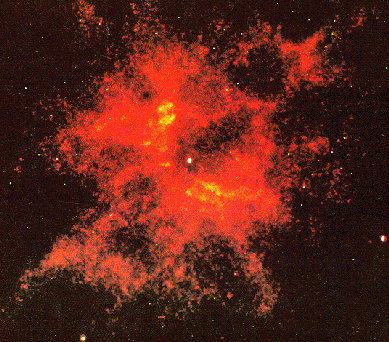
Let's start with CRL 618 as it's the easiest to see that the double jets have different 'angles' for their 'projection'.
Only a few hundred years ago CRL 618 appeared as a relatively modest Red Giant Star. Since then it has started to become a Stellar Glow Mode Z-Pinch Nebula. In its current phase, CRL 618 is evolving quickly, expelling complex jets and rings moving outwards at an estimated; faster than 700,000 kilometers per hour. In a few thousand years, our Mainstream Astrophysics Consensus Community predicts; "the glowing core of the cool Red Giant will be bare, revealing a hot White Dwarf star. Much remains unknown about planetary nebulae formation, including details of how geometries like this form." That's right !! Mainstream has no clear idea of what is actually happening in Reality in PNe !!! Additionally, Radio Astronomy has evidence that "CRL 618 has an extraordinary abundance of carbon-chain molecules."
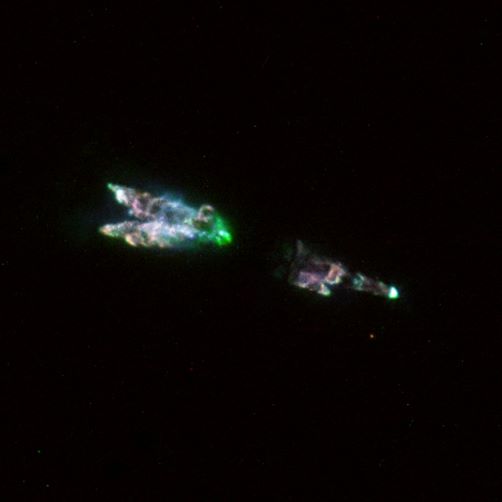
https://apod.nasa.gov/apod/ap000906.html
- -
NGC 2440
According to NASA scientists who write the text for the Astronomy Picture of the Day website (APOD) and which text is mostly included for each photo (but their ridiculous theorizing I deleted, as it is completely wrong).
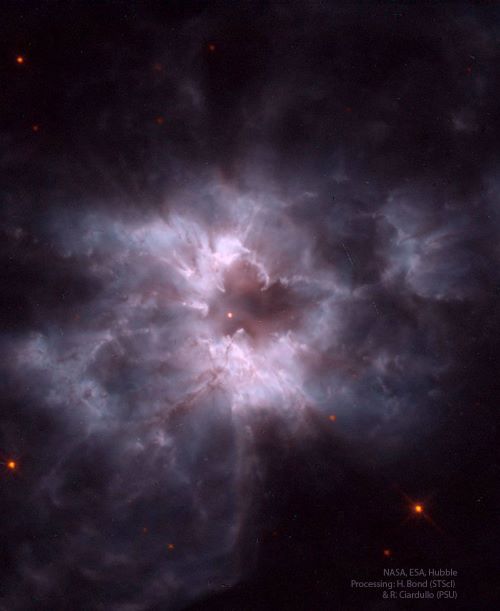
"What's that in the center ? Like a butterfly, a white dwarf star begins its life by casting off a cocoon of gas that enclosed its former self. In this analogy, however, the Sun would be a caterpillar and the ejected shell of gas would become the prettiest cocoon of all. In the featured cocoon, the planetary nebula designated NGC 2440 contains one of the hottest white dwarf stars known. The white dwarf can be seen as the bright orange dot near the image center."
"Planetary nebula NGC 2440 has an intriguing bow-tie shape in this stunning view from space. Details of remarkably complex structures are revealed within NGC 2440, including dense ridges of material swept back from the nebula's central star. Near the center of the view, the star itself is one of the hottest known, with a surface temperature of about 200,000 Kelvins. About 4,000 light-years from planet Earth toward the nautical constellation Puppis, the nebula spans over a light-year and is energized by ultraviolet light from the central star. The false-color image was recorded earlier this month using the Hubble's Wide-Field Planetary Camera 2(WFPC2), demonstrating still impressive imaging capabilities following the failure of the Advanced Camera for Surveys."
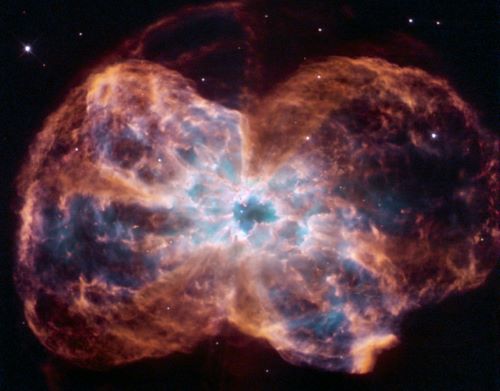
"In the center of the above photograph lies a star with one of the hottest surface temperatures yet confirmed. This bright white dwarf star's surface has been measured at greater than 200,000 degrees Celsius - more than 30 times hotter than that of our own Sun. The white dwarf's extreme heat makes it glow extraordinarily bright: intrinsically more than 250 times brighter than the Sun. The star is at the center of the planetary nebula titled NGC 2440, which lies inside our Milky Way Galaxy. The above computer sharpened image was taken by the Hubble Space Telescope."
https://apod.nasa.gov/apod/ap951130.html
- -
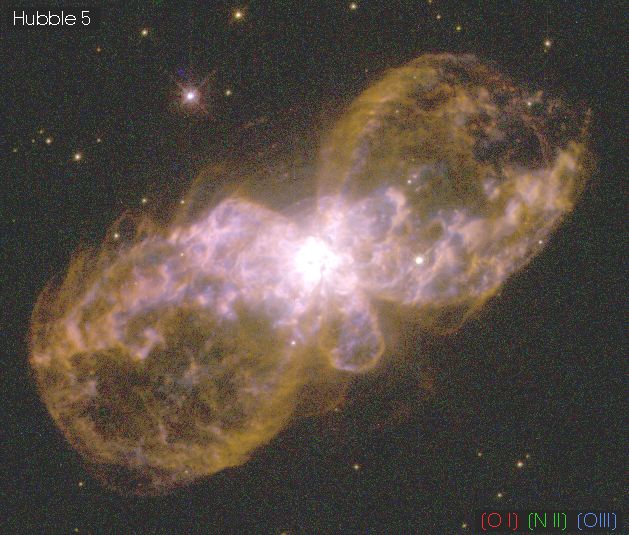
Hubble 5
"The Hubble Double Bubble Planetary Nebula is bubbling over with excitement. More mundanely known as Hubble 5, this bipolar planetary nebula is being created by a hot wind of particles streaming away from the central star system. The hot gas expands into the surrounding interstellar medium in a fashion similar to the inflation of hot air balloons. A supersonic shock-wave can form at the boundary, causing newly excited gas there to shine as electrons recombine with resident elements. In the above picture, colors are assigned according to the energy of the recombinant radiation. This star system lies about 2200 light-years from Earth, and likely includes a Sun-like star slowly transforming itself into a white dwarf."
https://apod.nasa.gov/apod/ap980119.html
- -
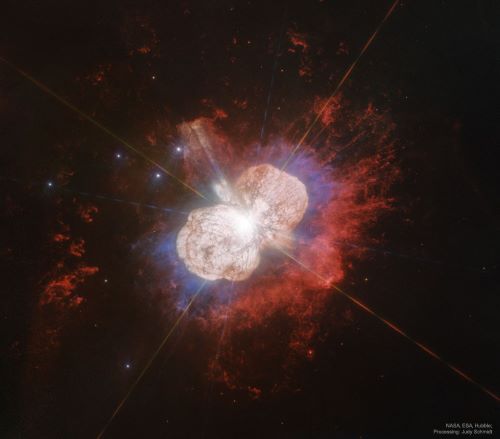
Eta Carinae
"The Carina Nebula is a large bright nebula that has several open star clusters within its boundaries. It contains two large OB associations (groups of stars that include stars of the spectral type O and B), Carina OB1 and Kiel OV2. The 70 light-year wide Carina OB1 association is the most massive association in our Galaxy and contains two star clusters: Trumpler 14 and Trumpler 16."
- -
Eta Carinae with the Homunculus Nebula
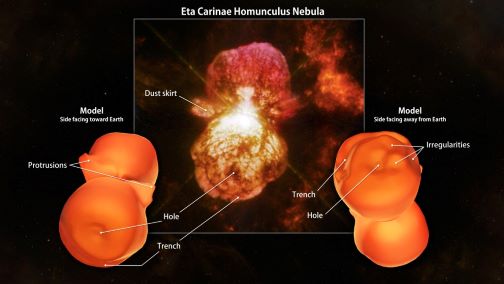
"If you're looking for something to print with that new 3D printer, try out a copy of the Homunculus Nebula. The dusty, bipolar cosmic cloud is around 1 light-year across but is slightly scaled down for printing to about 1/4 light-nanosecond or 80 millimeters. The full scale Homunculus surrounds Eta Carinae, famously unstable massive stars in a binary system embedded in the extensive Carina Nebula about 7,500 light-years distant. Between 1838 and 1845, Eta Carinae underwent the Great Eruption becoming the second brightest star in planet Earth's night sky and ejecting the Homunculus Nebula. The new 3D model of the still expanding Homunculus was created by exploring the nebula with the European Southern Observatory's VLT/X-Shooter. That instrument is capable of mapping the velocity of molecular hydrogen gas through the nebula's dust at a fine resolution. It reveals trenches, divots and protrusions, even in the dust obscured regions that face away from Earth. Eta Carinae itself still undergoes violent outbursts, a candidate to explode in a spectacular supernova in the next few million years."
https://apod.nasa.gov/apod/ap140717.html
- -
Calabash Nebula
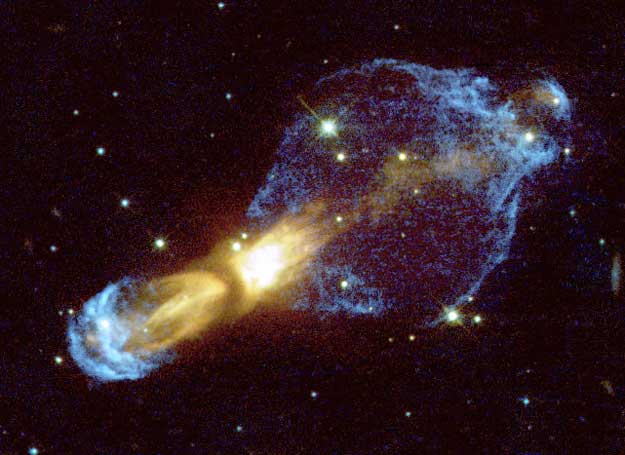
"Fast expanding gas clouds mark the end for a central star in the Calabash Nebula. The once-normal star has run out of nuclear fuel, causing the central regions to contract into a white dwarf. Some of the liberated energy causes the outer envelope of the star to expand. In this case, the result is a photogenic proto-planetary nebula. As the million-kilometer per hour gas rams into the surrounding interstellar gas, a supersonic shock front forms where ionized hydrogen and nitrogen glow blue. Thick gas and dust hide the dying central star. [ The star is NOT "dying" !!! it is now in a Z-Pinch !!! ] The Calabash Nebula, also known as the Rotten Egg Nebula and OH231.8+4.2 , will likely develop into a full bipolar planetary nebula over the next 1,000 years. The nebula, featured here, is about 1.4 light-years in extent and located about 5000 light-years away toward the constellation of Puppis."
https://apod.nasa.gov/apod/ap170215.html
APOD: 2001 September 3 - The Making of the Rotten Egg Nebula
"Explanation: Fast expanding gas clouds mark the end for a central star in the Rotten Egg Nebula. The once-normal star has run out of nuclear fuel, causing the central regions to contract into a white dwarf. Some of the liberated energy causes the outer envelope of the star to expand. In this case, the result is a photogenic proto-planetary nebula. As the million-kilometer per hour gas rams into the surrounding interstellar gas, a supersonic shock front forms where ionized hydrogen and nitrogen glow blue. The complex shock front had been hypothesized previously but never so clearly imaged. Thick gas and dust hide the dying central star. The Rotten Egg Nebula, also known as the Calabash Nebula and OH231.8+4.2 , will likely develop into a full bipolar planetary nebula over the next 1,000 years. The nebula, pictured above, is about 1.4 light-years in extent and located about 5000 light-years away toward the constellation of Puppis."
https://apod.nasa.gov/apod/ap010903.html
The Calabash Nebula has a large abundance of Hydrogen Sulfide molecules in its nebula ! Thus its moniker of the Rotten Egg Nebula ! Also, its shape is like a Calabash squash gourde !