Defense News, by Aditya Kumar
TEHRAN / STRAIT OF HORMUZ : Tensions in the Persian Gulf escalated sharply on Thursday as Iran’s Islamic Revolutionary Guard Corps (IRGC) Navy launched what it described as a large-scale “defensive swarm” operation, deploying submarines and coastal strike assets around the Strait of Hormuz as a U.S. aircraft carrier strike group moved closer to the region.
In a forceful statement carried by Iranian state media, Tehran warned that any “provocative entry” by U.S. naval forces into waters it claims as its own would trigger a decisive response, including the potential use of newly unveiled hypersonic weapons. The warning was issued as the USS Abraham Lincoln Carrier Strike Group maneuvered in the North Arabian Sea amid heightened regional alert levels.
A Chokepoint Under Pressure
The Strait of Hormuz, a narrow maritime corridor linking the Persian Gulf with the open ocean, carries roughly one-fifth of the world’s traded oil and remains one of the most strategically sensitive waterways on the planet. Even limited disruption can send shockwaves through global energy markets, shipping insurance rates, and diplomatic channels.
Satellite imagery reviewed by regional analysts and shipping monitors indicates a surge in Iranian naval activity near the eastern and western approaches to the Strait. According to officials familiar with the assessments, the IRGC Navy has dispersed surface combatants, fast-attack craft, and submarines into overlapping patrol zones designed to complicate detection and tracking.
Iranian commanders have framed the move as defensive, but Western officials see it as a calibrated signal aimed at deterring U.S. forces from entering the Gulf itself.
Submarines as the Centerpiece
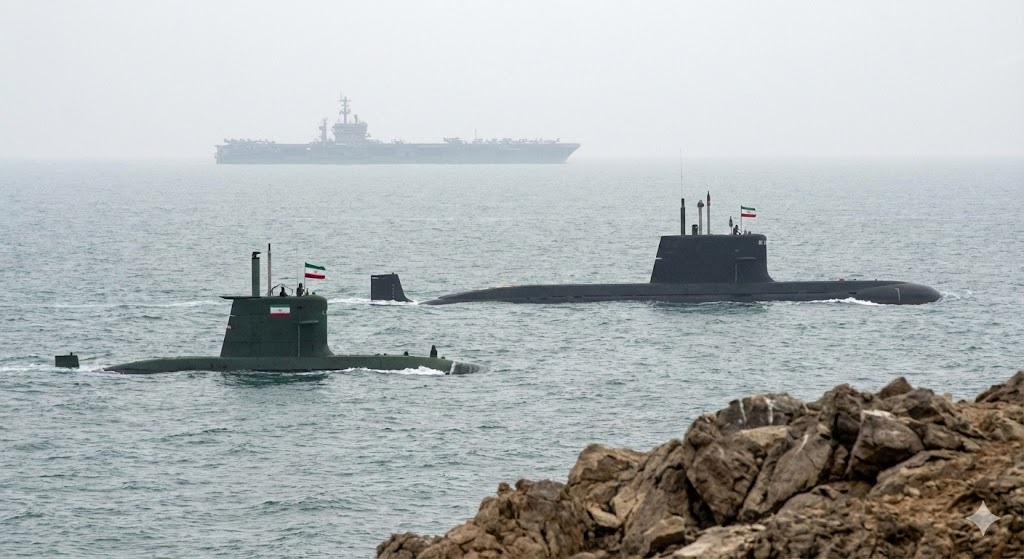
At the heart of the Iranian posture is a submarine deployment tailored to the Gulf’s shallow, acoustically complex waters. Defense officials say several Fateh-class submarines, semi-heavy diesel-electric boats optimized for regional operations, have taken up positions near key transit lanes. The class is believed to be capable of firing heavyweight torpedoes and anti-ship cruise missiles while submerged, giving Iran a stealth option against high-value naval targets.
More concerning to U.S. and allied planners is the apparent mass movement of Ghadir-class midget submarines. Small, slow, and difficult to detect, these vessels are designed for ambush operations close to shore. Western naval assessments have long warned that such platforms could be used to harass shipping, lay naval mines, or stage surprise torpedo attacks in the confined waters of the Strait.
Rear Admiral Alireza Tangsiri, commander of the IRGC Navy, said in remarks broadcast nationally that Iranian forces were prepared to act decisively.
“The enemy must understand that the Strait of Hormuz is not an arena for intimidation,” he said. “Our forces operate silently and patiently. Any miscalculation will carry consequences.”
Hypersonic Messaging
Adding a new dimension to the standoff, Iranian officials explicitly referenced the country’s hypersonic missile program as part of their deterrent posture. State television aired footage of what it identified as the Fattah-2 missile, describing it as capable of extreme speeds and advanced maneuverability intended to evade missile defenses.
Iranian media commentators argued that large surface combatants such as aircraft carriers present vulnerable targets in a conflict shaped by precision strike weapons. While independent analysts caution that public claims about hypersonic performance are difficult to verify, the rhetoric itself marks a notable escalation in tone, linking strategic missile forces directly to a naval confrontation.
U.S. Forces on Alert
The USS Abraham Lincoln (CVN-72), flagship of Carrier Strike Group Three, has remained outside the Strait in the North Arabian Sea, according to U.S. officials. The carrier is accompanied by guided-missile destroyers equipped with the Aegis combat system and layered air- and missile-defense capabilities.
Pentagon spokespeople declined to discuss specific Iranian deployments but emphasized that U.S. forces are operating in accordance with international law.
“The United States will continue to fly, sail, and operate wherever international law allows,” a spokesperson for U.S. Fifth Fleet said. “We are monitoring developments closely and remain prepared to defend our forces and ensure freedom of navigation.”
An Asymmetric Standoff
Military analysts describe the unfolding situation as a textbook example of asymmetric warfare. Rather than confronting U.S. naval power directly, Iran appears to be seeking to raise the cost and risk of any American move into the Persian Gulf by combining submarines, missiles, mines, and fast-attack craft in a dense threat environment.
“You don’t need outright victory at sea to achieve your objective,” said one Gulf-based security analyst. “If you can inject enough uncertainty into the calculations of a carrier commander or a shipping company, you’ve already altered behavior.”
That uncertainty is already rippling through commercial markets. Maritime insurers have reported rising premiums for vessels transiting the Strait, and several shipping companies said they were reviewing routes and contingency plans.
A Fragile Moment
Diplomats say back-channel communications remain active, but the risk of miscalculation is growing as forces operate in close proximity. Any incident — from a sonar contact to an aggressive maneuver by a patrol boat — could escalate rapidly in an environment saturated with weapons and rhetoric.
For now, the standoff has stopped short of open confrontation. But as submarines slip beneath the surface and carriers hold position over the horizon, the Strait of Hormuz once again stands at the center of a global test of resolve, restraint, and risk.
Source:
https://www.thedefensenews.com/news-details/Iran-Deploys-Ghadir-and-Fateh-Submarines-at-Hormuz-as-US-Carrier-Nears/