Greenland is ours by Right of Inheritance!
From a land up yonder, where walrus roam and the snow thunders....
By Clif High - January 18, 2026
The Greenland Promise: A True and Verifiable Account of the First Americans’ Inheritance
I have it on the highest authority—namely, a gentleman I met once in a St. Louis bar who claimed to have read it in a book he borrowed from his cousin’s wife’s uncle—that the continent of North America was promised long ago to the first honest folk who could find it and keep it warm. Not to any particular tribe or nation, mind you, but to whoever got there first with the most gumption and the least complaint about mosquitoes.
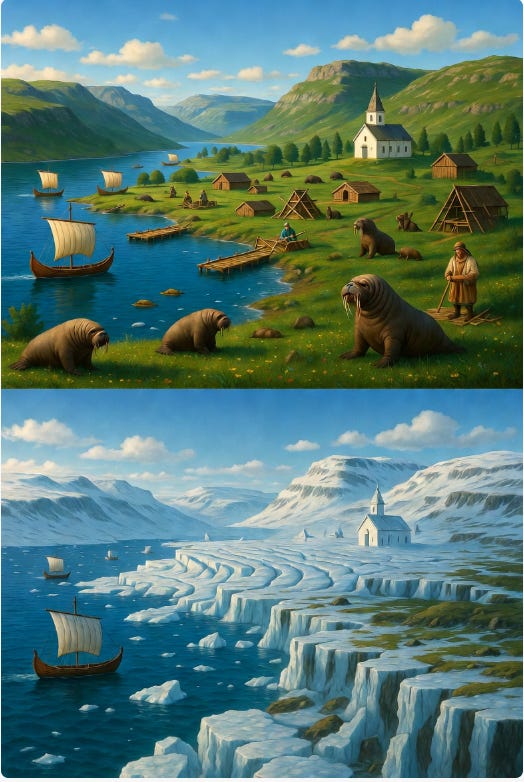
Now, the Almighty—or Nature, or whoever runs the real-estate office up yonder—had already handed out one fine piece of property to a people who knew how to appreciate green grass and milk cows. That piece was called Greenland. It was advertised in all the best Icelandic travel circulars as a land flowing with clover, fat sheep, and enough summer daylight to read the fine print on a mortgage by. Erik the Red, that red-headed real-estate promoter, named it Greenland for the same reason a man calls his bald horse “Curly”—to encourage emigration.
So the Norsemen packed up their longships, their axes, their Bibles (mostly for ballast), and sailed west. They found fjords deeper than a politician’s promises, meadows greener than envy, and walruses so plentiful a man could trip over one and claim it as homestead. They built farms, churches, barns bigger than some New England towns, and settled in for what they figured would be eternity. They even elected a bishop, which shows they were serious about civilizing the place.
Centuries rolled by like a slow-moving glacier. The Greenlanders prospered in their modest way—fishing, farming, trading ivory, and arguing about whose cow had the better right to the best patch of grass. They considered themselves the chosen people of the frozen north, heirs to a divine (or at least meteorological) covenant. The land was theirs by right of discovery, improvement, and not having anywhere else to go.
Then came the Little Ice Age, that uninvited guest who overstays his welcome worse than a relative from Ohio. The summers grew shorter, the winters longer, the hay thinner, and the promises thinner still. The walruses moved north for better accommodations. The grain stopped ripening. The sheep began to look at their owners with the same suspicion a man gives a tax collector. One by one the farms were abandoned, the churches stood empty, the bells froze in their towers, and the whole enterprise folded up like a bad poker hand.
Nobody knows exactly when the last Greenlander gave up and sailed away—perhaps to Iceland, perhaps to Valhalla, perhaps just to a warmer argument somewhere else. But the land stayed right where it was, empty, white, and waiting.
Now here is the humorous part, the part that would make even a dead man chuckle if he had any breath left. When the first real Americans—those hardy pilgrims and pioneers who crossed the Atlantic much later—finally got around to claiming their inheritance, they looked north and said, “By thunder, that looks like a fine piece of real estate! Green-land, they call it? Well, we’ll take it off the market.”
But by then the deed had expired. The covenant had run out like a subscription to a newspaper nobody reads anymore. The ice had thickened, the promises had cooled, and Greenland sat there looking innocent, as if it had never heard of any chosen people at all.
So the Americans, being practical folk, did what any sensible inheritor does when the will is missing: they bought it from somebody else who had never lived there either. And now and then, when a congressman or a speculator stands on the deck of a ship staring at those ice cliffs and mutters, “This here’s our promised land,” I reckon old Erik the Red, wherever he is, gives a ghostly laugh and says:
“Promised land? Son, we tried that once. The mortgage payments are murder, the winters last nine months, and the only thing that flows is the meltwater in July. Take my advice—stick to the Mississippi. At least it thaws every spring.”
And that’s how Greenland became the inheritance nobody quite claimed, the Promised Land that kept its promise by staying empty. A man can’t help but admire the joke. It’s got the mark of genuine Providence on it—quiet, dry, and delivered with perfect timing.
*********************