By Carlo Mattogno - November 15, 2022
According to the orthodox narrative, spring and summer of 1944 represent the crucial phase of the alleged extermination of the jews at Auschwitz. During that time, it is claimed, such an enormous number of jews was deported to Auschwitz and allegedly gassed there that the Birkenau cremation furnaces were no longer able to incinerate the masses of gassed people, and the SS was forced to resort to open-air incinerations.
In spite of the fact that the alleged mass-incineration trenches played an essential part especially during this period, orthodox holocaust historiography is extremely vague in this respect.
Orthodox historiography is unable to say anything specific about the dimensions, the location or the number of these alleged mass-incineration trenches, which means that the assertions of individual historians like Jean Claude Pressac (see Chapter 5) represent nothing but their own personal conjectures. This is due to the fact that the story of mass-incineration trenches is based exclusively on testimonies and that these testimonies, as we shall see in Chapter 4, are contradictory in every regard so as to preclude any historically verified conclusions.
The first reports concerning incineration trenches at Birkenau in 1944 came from the underground resistance movement at Auschwitz. The “Periodic report for May 5 through 25, 1944” contains a section entitled “The death factory” which asserts the following:
“The 4 crematoria in operation have ‘handled’ up to 5000 (persons) per day. The Auschwitz furnaces have ‘handled’ 1,500,000 jews, plus 100,000 Poles, Russians and others.”
As results from the study of the groundwater level at Birkenau (see Part Three of the present study), the depth of the cremation pits was limited to one meter or less, which means that they could at best contain one layer of wood and bodies.
The only system of cremation that could be realized in this way was the pyre: arrangement of the corpses on a layer of wood and setting it on fire. The kind of continuous operation described by some witnesses – corpses thrown into a trench already on fire – could not have been implemented for two reasons:
1. The temperature of the trench would not have permitted an approach close enough for a body to be thrown into the fire. Even if the persons assigned to this job had worn protective clothing (something no witness has ever mentioned), they could only have launched the bodies to within a few meters of the trench. Such corpses would have accumulated outside of the edge of the trench without increasing the cremation capacity in any way.
2. The cremation of a corpse in a cremation trench would require an average of some 200 kg of wood. Hence, total wood consumption up to May 31, 1944 would have amounted to (117,700 × 200 =) 23,540,000 kg or 23,540 metric tons of wood, with an average daily consumption of (7,850 × 200 =) 1,570,000 kg or 1,570 metric tons of wood.
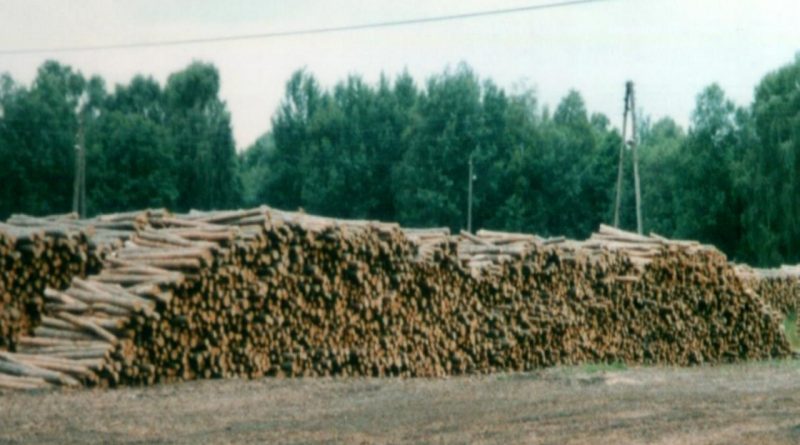
To help the reader visualize what this quantity of wood really means, I include a photograph taken by me in 1997 near the former camp at Sobibór [see feature image]. One can see enormous piles of wood (see Document 45). In the foreground, we have a pile some 30 meters long and on average 2.5 meters high, constituted by pine trunks about 3 meters long and 10-15 cm in diameter. The weight of this pile is about 120 tons, sufficient to burn about 600 corpses. The daily requirements for the alleged Birkenau cremations – 1,570 tons – would have been equivalent to 13 piles of wood such as the one shown in the photograph.
A growth of fir trees will produce, over a period of 50 years, about 496 tons per hectare or about 200 tons per acre. Thus, the total consumption of wood up to May 31, 1944 would have been equivalent to the deforestation of over 47 hectares (or about 120 acres or 0.18 square miles) of fir growth, and the daily needs would have required all the wood grown on over 3 hectares (or about 8 acres) of forest.
The combustion of this enormous amount of wood, if we assume an experimental content of 8% of ash, would have produced (23,540 × 0.08 =) 1,883.2 tons of ash overall, or some (1,570 × 0.08 =) 125.6 tons of ash per day, corresponding to about (125.6 ÷ 0.34 =) 370 m³ or 26 truckloads. The cremation of a corpse yields about 5% of incombustible ash with a density of 0.5 g/cm³. Up to May 31, 1944, we would thus have (117,700 × 58 × 0.05 =) 341,330 kg or 341.33 tons of human ash. The daily amount would be (7,850 × 58 × 0.05 =) 22,765 kg or 22.7 tons.
Hence, the total amount of ash from both sources would be (1,883.2 + 341.3 =) 2,224.5 tons with an average daily rate of (125.6 + 22.7 =) 148.3 tons. To this has to be added an undetermined amount of incompletely burned wood and corpse parts, as they inevitably occur during pyre incinerations.
According to orthodox historiography, the ash was loaded on trucks and dumped into the Vistula River or used as fertilizer on the farms! For the sifting of the ash, eight sieves were available, similar to those used for sand. Thus each sieve would have been used for (148.3 ÷ 8 =) 18.5 tons or some 52 m³ of ash per day!
Hence, if the story of the cremation of the “Hungarian” jews were true, then the air photos taken on May 31, 1944 would have to show . . .
[SNIP]