By substack.com - February 8, 2022
Eisenhower feared the rise and dominance of the military and industrial might that had driven fascism and imperialism to the fore in the 1930’s.
He saw it in Germany, in Italy, and in Japan. He saw it ongoing in the united states and in the soviet union and the cold war that was ripe to be waged and to come to dominate public perception and geopolitics as a result. largely, he was correct. for this reason, his farewell address is well remembered for its warnings against the “military industrial complex.”
"In the councils of government, we must guard against the acquisition of unwarranted influence, whether sought or unsought, by the military-industrial complex. The potential for the disastrous rise of misplaced power exists and will persist. We must never let the weight of this combination endanger our liberties or democratic processes.
We should take nothing for granted. Only an alert and knowledgeable citizenry can compel the proper meshing of the huge industrial and military machinery of defense with our peaceful methods and goals, so that security and liberty may prosper together."
This is a wise and principled man who had seen enough of war and of war mongers to wish to see no more.
His stark warnings about industry and government riding around in the same car resulting in the driving over of we the people and the need for an informed, alert public protective of its liberty and agency that it might thrive and prosper in freedom rings as true to today as it did then.
Oracular as this was, even more prescient was this less remembered but, to my mind, far more presently important admonition:
Akin to, and largely responsible for the sweeping changes in our industrial-military posture, has been the technological revolution during recent decades.
In this revolution, research has become central, it also becomes more formalized, complex, and costly. A steadily increasing share is conducted for, by, or at the direction of, the Federal government.
The prospect of domination of the nation’s scholars by Federal employment, project allocation, and the power of money is ever present and is gravely to be regarded.
Yet in holding scientific discovery in respect, as we should, we must also be alert to the equal and opposite danger that public policy could itself become the captive of a scientific-technological elite.
Because unlike many generals who are mired in the past and determined to fight the last war, ike saw the shape of the war to come for this, not the arms races of great powers, is the threat to the lives and livelihoods of today and it is further reaching and holds the potential to be FAR more terrible.
This Is The “Tyranny Of Experts” And The Utter Dominance Of Discourse And The Foundational Freedoms And Order Of Society That It Can Attain
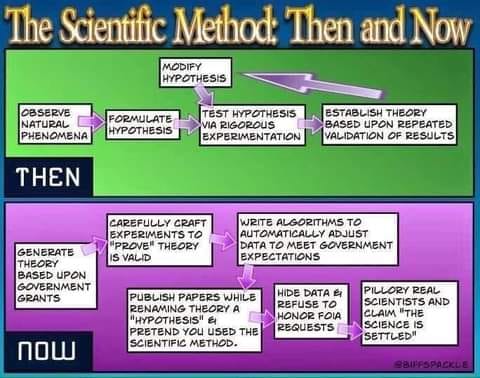
Such technocratic domination comes to pass because of a feedback loop that establishes the framework, both political and scientific, to create a “rule by experts.”
The problem is that by the time this loop has run, there are not experts, merely commissars, chosen and promoted for fealty, not foresight or accuracy. science becomes a guild of medieval bards singing the false praises of feckless leaders because more so now that ever, science runs on money and just as in the courts of kings, he who pays the piper shall call the tune.
The government picks scientists who tell it what it wants to hear. these are elevated. others are starved. soon, anyone entering a field knows that “if you want have a career, you need to study X and your conclusions must look like Y.” this is not exploration, it’s justification. this, in turn, supports the “right sort of government,” a technocratic government, not one pushing choice or a small state. that’s no use to the grant grabbers and subsidy snufflers. so “the science” always comes down on the side of fascist systems because that’s where the gravy train is.
And this is a bad, bad cycle for those in search of personal rights and agency, for the whole point of a technocratic state is to tell you what to do for your own good and get rich and powerful while doing so.
So it all comes down to money and who gets to hand it out.
The grant and subsidy system for american science has become VAST and this vastness poses several problems:
1. It crowds out private science. you cannot compete against those getting free money with money you have to raise, pay back, and provide return upon. this is especially true in basic science whose time to return is longer and outcomes less certain. this pushes the private sector out of entire fields.
2. It allocates funding based on non-market considerations. there is no valid system to compare alternative uses of scarce capital. it is instead allocated using patronage and the preferences of bureaucrats aspiring to be princes. this becomes both self serving and self supporting.
3. It results in deep and enduring regulatory and public choice capture. This concentrates the power of the purse and thereby the power to literally direct and shape the sweep of scientific endeavor into the hands of a small, unaccountable aristocracy who in turn, feed a set of select universities, ideologies, and organizations drawing them into their financial and dogmatic orbits. and the gravity of such systems comes to dominate everything.
The establishment of such systems is always done for what sound like the best of reasons. “the government should fund studies in tropical diseases!” this sounds great. who is not favor of more tropical disease solutions? let’s cure it! huzzah!
But this is a trap.
It’s easy to pass this off to the citizenry as “the good kind of government” and the “solving of real problems to the benefit of the general welfare.” but it’s not. generally, it’s a huge waste, a carnival of cronyism, and the setup for the ideological domination of science by a few unaccountable agents so that that science can, in turn, be used to justify and dominate government opposing anything remotely libertarian in favor of central planning . . .
[SNIP]