Note: I am also a licensed ham radio operator, having received my license last year.
-NW
Former Air Force Officer Gives A Stern Warning
Article by Col. Randall Smith, Ph.D., Commander, NECN
contributing writer for geoengineeringwatch.org
Apr 18, 2016
http://bit.ly/1YHwMT9
To a very great extent, America is fighting several wars – some on foreign soil, one on our own. Aside from disrupting or eliminating the flow of items key to survival (clean water, nourishment, sanitary living conditions, etc.), governments (federal and state) are executing plans for complete disruption of our usual means of communication. This includes telephony in all of its forms (land-lines, cellular, VOiP) and the internet. You are already acutely aware of the "blackout" of the major news organizations, all of which are owned and controlled by major corporations or "banksters".
I am a former USAF electronics/communications officer and a licensed amateur radio operator. Several years ago, as I began to learn more of what at the time seemed to be literally unbelievable, I thought about the need for an emergency communications network that would reach beyond our shores and borders and to which every American could have access for a nominal cost in equipment and without a license from the now DHS dominated Federal Communications Commission.
...
Until we learn otherwise, we have several communicative options currently at our disposal. Many of you remember the days when CB (Citizens Band) radios were popular, and some of you may still own one. Well, they are popular again. If you own one, you may wish to consider dusting it off, installing an antenna (preferably outdoor) and providing it with 12 volt D.C. power from a power supply, a boat or car battery or your solar power system. Channel 3 has been designated as the national CB emergency frequency. If your radio has single side-band capability, channel 36 LSB (lower side-band) is also available as an emergency frequency. Single side-band signals use a narrower slice of the radio spectrum, travel greater distances than other modes of communication, and are slightly less affected by man-made or naturally occurring noise.
In recent years, a relatively new radio service which uses hand-held, low power radios has become very popular among campers, boaters, hunters and others. These radio utilize the "Family Radio Service" or FRS. An FCC license is not required to use this service. These radios have a range, depending upon terrain, obstacles and weather, of about 2-6 miles (despite inordinate claims of greater ranges by manufacturers). As with CB frequencies or channels, channel 3 has been designated as an emergency or calling frequency for FRS radios. FRS radios share several frequencies or channels with another, older radio service, The General Mobile Radio Service or GMRS. These radios are a more powerful alternative as they are typically installed in vehicles. However, just as with CB radios, providing them with a 12 volt D.C. power source will allow them to work in any location...
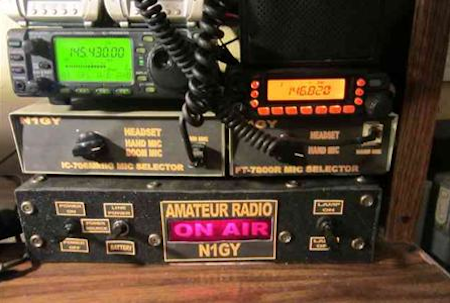
The mainstay and bedrock of reliable, long-distance radio communication is amateur radio. Amateur radio operators and experimenters have contributed significantly to the body of knowledge surrounding electronic human audio and video communications for decades, and have earned many of their operating privileges from the FCC because of their efforts, particularly during major wars. Both amateur radio operators and the military use similar frequencies which is both an advantage (intel or gathering intelligence information) and a disadvantage (comsec or communications security e.g. monitoring). Amateur radio signals are capable of traveling all over the world, either by traditional ionospheric propagation or via amateur radio satellites.
Because of their power capability (up to 1,500 watts) and the wide range of frequencies on which they can operate, only amateur radio stations participate in the emergency communications networks themselves. Just as there are ways to interfere with signal propagation (e.g. "jamming"), there are effective technique for circumventing jamming. Amateur radio operators communicate using conventional voice transmissions of various types (CW (Morse code), AM, FM, USB, LSB) or via computerized digital communications. These amateur stations are referred to as "net control" stations. Depending upon the current alert level, they are prepared to operate 24/7. Part of my initial goal was to make emergency communication available to as many Americans as possible.