This classic science fiction story was written in 1942, but has aged well and is quite apropos today. It is set 7,000 years in the future, a future that nevertheless has settled into a pattern recognizable in its timeless similarity to the people and institutions of our own world.
Full rather longish short story at:
http://prosperosisle.org/spip.php?article880
~~~~~ INTRO EXCERPT ~~~~~~
THE VILLAGE at night made a curiously timeless picture. Fara walked contentedly beside his wife along the street. The air was like wine; and he was thinking dimly of the artist who had come up from Imperial City, and made what the telestats called—he remembered the phrase vividly—" a symbolic painting reminiscent of a scene in the electrical age of seven thousand years ago."
Fara believed that utterly. The street before him with its weedless, automatically tended gardens, its shops set well back among the flowers, its perpetual hard, grassy sidewalks, and its street lamps that glowed from every pore of their structure—this was a restful paradise where time had stood still.
And it was like being a part of life that the great artist’s picture of this quiet, peaceful scene before him was now in the collection of the empress herself. She had praised it, and naturally the thrice-blest artist had immediately and humbly begged her to accept it.
What a joy it must be to be able to offer personal homage to the glorious, the divine, the serenely gracious and lovely Innelda Isher, one thousand one hundred eightieth of her line.
As they walked, Fara half turned to his wife. In the dim light of the nearest street lamp, her kindly, still youthful face was almost lost in shadow. He murmured softly, instinctively muting his voice to harmonize with the pastel shades of night:
"She said—our empress said—that our little village of Glay seemed to her to have in it all the wholesomeness, the gentleness, that constitutes the finest qualities of her people. Wasn’t that a wonderful thought, Creel? She must be a marvelously understanding woman.
He stopped. They had come to a side street, and there was something about a hundred and fifty feet along it that—
"Look!" Fara said hoarsely.
He pointed with rigid arm and finger at a sign that glowed in the night, a sign that read:
FINE WEAPONS
THE RIGHT TO BUY WEAPONS IS THE RIGHT TO BE FREE
Fara had a strange, empty feeling as he stared at the blazing sign. He saw that other villagers were gathering. He said finally, huskily:
"I’ve heard of these shops. They’re places of infamy, against which the government of the empress will act one of these days. They’re built in hidden factories, and then transported whole to towns like ours and set up in gross defiance of property rights. That one wasn’t there an hour ago."
Fara’s face hardened. His voice had a harsh edge in it, as he said: "Creel, go home."
Fara was surprised when Creel did not move off at once. All their married life, she had had a pleasing habit of obedience that had made cohabitation a wonderful thing. He saw that she was looking at him wide-eyed, and that it was a timid alarm that held her there. She said:
"Fara, what do you intend to do? You’re not thinking of—"
"Go home!" Her fear brought out all the grim determination in his nature. "We’re not going to let such a monstrous thing desecrate our village. Think of it"—his voice shivered before the appalling thought—"this fine, old-fashioned community, which we had resolved always to keep exactly as the empress has it in her picture gallery, debauched now, ruined by this . . . this thing— But we won’t have it; that’s all there is to it."
Creel’s voice came softly out of the half-darkness of the street corner, the timidity gone from it: "Don’t do anything rash, Fara. Remember it is not the first new building to come into Glay—since the picture was painted."
Fara was silent. This was a quality of his wife of which he did not approve, this reminding him unnecessarily of unpleasant facts. He knew exactly what she meant. The gigantic, multi-tentacled corporation, Automatic Atomic Motor Repair Shops, Inc., had come in under the laws of the State with their flashy building, against the wishes of the village council—and had already taken half of Fara’s repair business.
"That’s different!" Fara growled finally. "In the first place people will discover in good time that these new automatic repairers do a poor job. In the second place it’s fair competition. But this weapon shop is a defiance of all the decencies that make life under the House of Isher such a joy. Look at the hypocritical sign: ’The right to buy weapons—’ Aaaaahh!"
He broke off with: "Go home, Creel. We’ll see to it that they sell no weapons in this town."
He watched the slender woman-shape move off into the shadows. She was halfway across the street when a thought occurred to Fara. He called:
"And if you see that son of ours hanging around some street corner, take him home. He’s got to learn to stop staying out so late at night."
The shadowed figure of his wife did not turn; and after watching her for a moment moving along against the dim background of softly glowing street lights, Fara twisted on his heel, and walked swiftly toward the shop. The crowd was growing larger every minute, and the night pulsed with excited voices.
Beyond doubt, here was the biggest thing that had ever happened to the village of Glay.
The sign of the weapon shop was, he saw, a normal-illusion affair. No matter what his angle of view, he was always looking straight at it. When he paused finally in front of the great display window, the words had pressed back against the store front, and were staring unwinkingly down at him.
Fara sniffed once more at the meaning of the slogan, then forgot the simple thing. There was another sign in the window, which read:
THE FINEST ENERGY WEAPONS IN THE KNOWN UNIVERSE
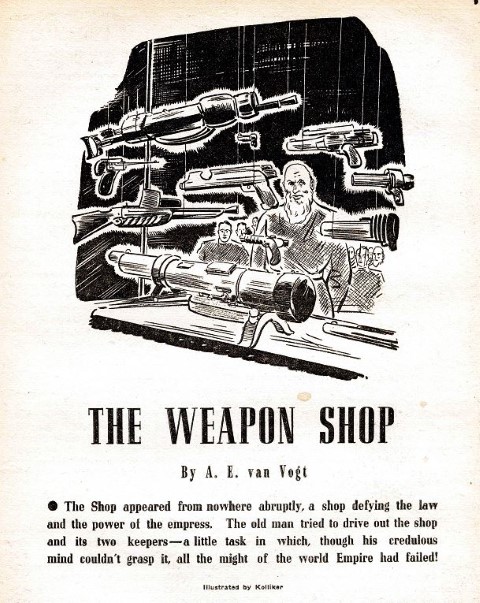
A spark of interest struck fire inside Fara. He gazed at that brilliant display of guns, fascinated in spite of himself. The weapons were of every size, ranging from tiny little finger pistols to express rifles. They were made of every one of the light, hard, ornamental substances: glittering glassein, the colorful but opaque Ordine plastic, viridescent magnesitic beryllium. And others.
It was the very deadly extent of the destructive display that brought a chill to Fara. So many weapons for the little village of Glay, where not more than two people to his knowledge had guns, and those only for hunting. Why, the thing was absurd, fantastically mischievous, utterly threatening.
Somewhere behind Fara, a man said: "It’s right on Lan Harris’s lot. Good joke on that old scoundrel. Will he raise a row!"
There was a faint titter from several men, that made an odd patch of sound on the warm, fresh air. And Fara saw that the man had spoken the truth. The weapon shop had a forty-foot frontage. And it occupied the very center of the green, garden-like lot of tight-fisted old Harris.
Fara frowned. The clever devils, the weapon-shop people, selecting the property of the most disliked man in town, coolly taking it over and giving everybody an agreeable titillation. But the very cunning of it made it vital that the trick shouldn’t succeed.
He was still scowling anxiously when he saw the plump figure of Mel Dale, the mayor. Fara edged toward him hurriedly, touched his hat respectfully, and said:
"Where’s Jor?"
"Here." The village constable elbowed his way through a little bundle of men. "Any plans?" he said.
"There’s only one plan," said Fara boldly. "Go in and arrest them."
To Fara’s amazement, the two men looked at each other, then at the ground. It was the big constable who answered shortly:
"Door’s locked. And nobody answers our pounding. I was just going to suggest we let the matter ride until morning."
"Nonsense!" His very astonishment made Fara impatient. "Get an ax and we’ll break the door down. Delay will only encourage such riffraff to resist. We don’t want their kind in our village for so much as a single night. Isn’t that so?"
There was a hasty nod of agreement from everybody in his immediate vicinity. Too hasty. Fara looked around puzzled at eyes that lowered before his level gaze. He thought: "They are all scared. And unwilling." Before he could speak, Constable Jor said:
"I guess you haven’t heard about those doors or these shops. From all accounts, you can’t break into them."
It struck Fara with a sudden pang that it was he who would have to act here. He said, "I’ll get my atomic cutting machine from my shop. That’ll fix them. Have I your permission to do that, Mr. Mayor?"
In the glow of the weapon-shop window, the plump man was sweating visibly. He pulled out a handkerchief, and wiped his forehead. He said:
"Maybe I’d better call the commander of the Imperial garrison at Ferd, and ask them."
"No!" Fara recognized evasion when he saw it. He felt himself steel; the conviction came that all the strength in this village was in him. "We must act ourselves. Other communities have let these people get in because they took no decisive action. We’ve got to resist to the limit. Beginning now. This minute. Well?"
The mayor’s "All right!" was scarcely more than a sigh of sound. But it was all Fara needed.
He called out his intention to the crowd; and then, as he pushed his way out of the mob, he saw his son standing with some other young men staring at the window display.
Fara called: "Cayle, come and help me with the machine."
Cayle did not even turn; and Fara hurried on, seething. That wretched boy! One of these days he, Fara, would have to take firm action there. Or he’d have a no-good on his hands.
The energy was soundless—and smooth. There was no sputter, no fireworks. It glowed with a soft, pure white light, almost caressing the metal panels of the door—but not even beginning to sear them.
Minute after minute, the dogged Fara refused to believe the incredible failure, and played the boundlessly potent energy on that resisting wall. When he finally shut off his machine, he was perspiring freely.
"I don’t understand it," he gasped. "Why—no metal is supposed to stand up against a steady flood of atomic force. Even the hard metal plates used inside the blast chamber of a motor take the explosions in what is called infinite series, so that each one has unlimited rest. That’s the theory, but actually steady running crystallizes the whole plate after a few months."
"It’s as Jor told you," said the mayor. "These weapon shops are—big. They spread right through the empire, and they don’t recognize the empress."
Fara shifted his feet on the hard grass, disturbed. He didn’t like this kind of talk. It sounded—sacrilegious. And besides it was nonsense. It must be. Before he could speak, a man said somewhere behind him:
"I’ve heard it said that that door will open only to those who cannot harm the people inside."
The words shocked Fara out of his daze. With a start, and for the first time, he saw that his failure had had a bad psychological effect. He said sharply:
"That’s ridiculous! If there were doors like that, we’d all have them. We—"
The thought that stopped his words was the sudden realization that he had not seen anybody try to open the door; and with all this reluctance around him it was quite possible that—
He stepped forward, grasped at the doorknob, and pulled. The door opened with an unnatural weightlessness that gave him the fleeting impression that the knob had come loose into his hand. With a gasp, Fara jerked the door wide open.
"Jor!" he yelled. "Get in!"
The constable made a distorted movement—distorted by what must have been a will to caution, followed by the instant realization that he could not hold back before so many. He leaped awkwardly toward the open door—and it closed in his face.
Fara stared stupidly at his hand, which was still clenched. And then, slowly, a hideous thrill coursed along his nerves. The knob had —withdrawn. It had twisted, become viscous, and slipped amorphously from his straining fingers. Even the memory of that brief sensation gave him a feeling of unnormal things.
He grew aware that the crowd was watching with a silent intentness. Fara reached again for the knob, not quite so eagerly this time; and it was only a sudden realization of his reluctance that made him angry when the handle neither turned nor yielded in any way.
Determination returned in full force, and with it came a thought. He motioned to the constable. "Go back, Jor, while I pull."
The man retreated, but it did no good. And tugging did not help. The door would not open. Somewhere in the crowd, a man said darkly:
"It decided to let you in, then it changed its mind."
"What foolishness are you talking!" Fara spoke violently. "It changed its mind. Are you crazy? A door has no sense."
But a surge of fear put a half-quaver into his voice. It was the sudden alarm that made him bold beyond all his normal caution. With a jerk of his body, Fara faced the shop.
The building loomed there under the night sky, in itself bright as day, huge in width and length, and alien, menacing, no longer easily conquerable. The dim queasy wonder came as to what the soldiers of the empress would do if they were invited to act. And suddenly—a bare, flashing glimpse of a grim possibility—the feeling grew that even they would be able to do nothing.
Abruptly, Fara was conscious of horror that such an idea could enter his mind. He shut his brain tight, said wildly:
"The door opened for me once. It will open again."
It did. Quite simply it did. Gently, without resistance, with that same sensation of weightlessness, the strange, sensitive door followed the tug of his fingers. Beyond the threshold was dimness, a wide, darkened alcove. He heard the voice of Mel Dale, the mayor, behind him saying:
"Fara, don’t be a fool. What will you do inside?"
Fara was vaguely amazed to realize that he had stepped across the threshold. He turned, startled, and stared at the blur of faces. "Why—" he began blankly; then he brightened; he said, "Why, I’ll buy a gun, of course."
The brilliance of his reply, the cunning implicit in it, dazzled Fara for half a minute longer. The mood yielded slowly, as he found himself in the dimly lighted interior of the weapon shop.
~~~~~ much more at ~~~~~
http://prosperosisle.org/spip.php?article880