Pensions should be negated by failure to operate within constitutional bounds.
~~~
Taxpayer-funded Pension and Perks of Former U.S. Officials | HowStuffWorks
https://people.howstuffworks.com/pay-pension-us-government-employees.htm
by Michelle Konstantinovsky Oct 16, 2018
Former U.S. Presidents Jimmy Carter, George H.W. Bush, George W. Bush, Barack Obama and Bill Clinton all are eligible for generous benefits as part of the Former Presidents Act. Gary Miller/Getty Images
People don't typically get into U.S. politics for big bucks. Sure, there are a lot of other prestigious perks that come along with a high-ranking position, but government jobs aren't typically known to be the most lucrative employment opportunities. And let's be real: The true "value" of public service has seen better days.
Take the U.S. president, for example. While the annual salary ($400,000) dwarfs that of the median American income ($59,039), but it's not much more than a top-tier tech executive in the Bay Area ($316,763). So while a hefty paycheck may not be the most impressive piece of a politician's profile, aren't you a little curious what some government officials make? And how long do they have to work before they're paid for life (because that's a thing)? Wonder no more.
Presidential Perks
But let's get back to the president. We know the annual salary isn't astronomical, but what about the post-White House perks? The Former Presidents Act of 1958 (FPA) was enacted to "maintain the dignity" of the office of the president. Along with being a former president (and his or her spouse) comes a lot of perks, including lifelong Secret Service protection.
But former presidents also receive a pension that is equal to the annual salary for cabinet secretaries; in 2017, that amount was $207,800. But that's not all. The FPA also provides former U.S. presidents with a slew of other perks, including support staff, office space, travel funds and even free postage, all funded by taxpayers of course. Fox News reported that in 2017, former President Barack Obama was approved for $536,000 for office space in D.C., while Bill Clinton received $518,000 for his New York City office and George W. Bush got $497,000 for his space in Dallas.
Retiring in Style
When it comes to members of U.S. Congress, annual pay is pretty cut and dry: Salary for most is $174,000 per year (though those in leadership positions like the Speaker of the House make more). According to PolitiFact, a long-standing urban legend has convinced many people over the years that rank-and-file members of the House of Representatives only have to serve for two years in order to receive $174,000 annually for the rest of their lives. Unfortunately for members of Congress, the legend is, well, a legend.
A report on "Retirement Benefits for Members of Congress" stipulates that no member of Congress is eligible to receive pension until they've served for at least five years (senators serve six-year terms, but members of the House have to seek reelection every two years). There are other provisions as well: The congressperson or senator has to be 62 years old or at least 50 with 20 years of service (or, if they're whiz kids, they can be any age, as long as they've served for 25 years) before they can begin receiving their pension.
And that $174,000 rumor isn't quite right either. According to the Federal Employees Retirement System (FERS), basic pension plans depend on their years of service and the representative's "high-3" average (i.e. their three highest-paid consecutive years of service). There's some other math that goes into figuring out the final number, but, for example, a rank-and-file member who's served for 25 years can expect to take home about $67,250 per year in pension. But a congressperson who's only served three terms (or one if they're a senator) might only get $17,588 if they retire after six years.
Members of Congress can also enjoy other retirement benefits thanks to FERS: Social Security and the Thrift Savings Plan (TSP). If a government employee is covered by FERS, they pay into their Social Security fund at the same rate as private employees. But they also have the option to invest in the TSP, which is available to all federal employees and is similar to a 401(k). According to Investopia, what's so great about the TSP is the plan has super-low operating expenses compared to those outside of the TSP (38 cents in expenses for every $1,000 invested compared to $1.20 per $1,000 invested). That means their nest egg grows faster than most because low expenses help them achieve "high long-term investment returns." Not too shabby if you can put up with everything else that goes along with public service these days.
~~~
Latest study on federal compensation puts public, private pay gap at widest margin yet - Federal News Network
https://federalnewsnetwork.com/your-money/2017/09/latest-study-on-federal-compensation-puts-public-private-pay-gap-at-widest-margin-yet/
By Nicole Ogrysko
September 25, 2017 2:58 pm
With the release of every new study examining federal employee compensation comes different numbers and familiar arguments.
But a recent report from the Cato Institute’s “Downsizing the Federal Government” project describes, by far, the largest pay and compensation gap yet between public and private sector workers.
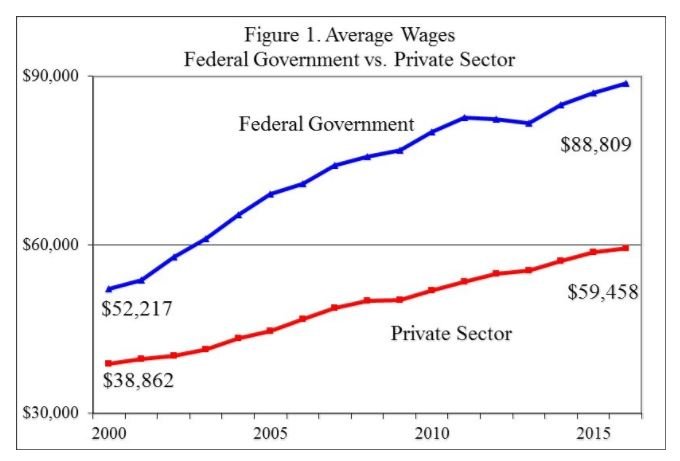
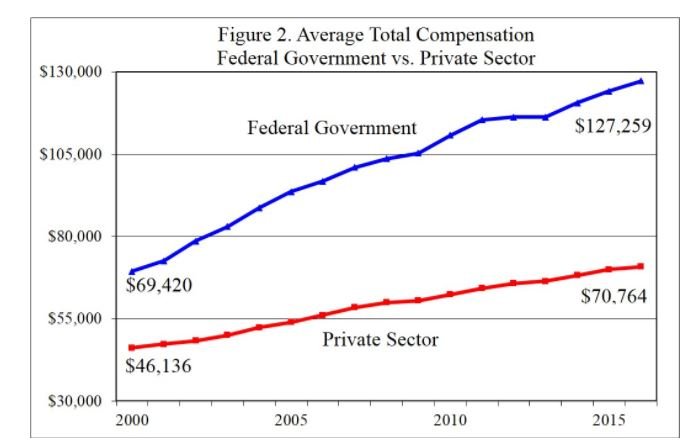
Federal employees earned 80 percent more in 2016 compared to private sector workers, according to Chris Edwards, director of tax policy studies at Cato. Federal employees earn 42 percent more than state and local government workers, he added.
Edwards used Bureau of Economic Analysis data to compare average wages and benefits for the 2.1 million federal civilian employees to the average compensation for the nation’s 114 million private sector workers.
The federal average, according to Edwards, has grown significantly higher than the private sector in the past 15 years.
Adding benefits such as health care and retirement, federal employees have a higher advantage than private sector workers. Average federal compensation reached $127, 259 in 2016, while private sector averages topped out at $70,764 — or $56, 495 lower.
Cato’s latest study comes as some lawmakers have suggested they’re determined to make major changes to federal pay and benefits.
But federal employee groups, unions and some lawmakers argue these comparisons are a pointless exercise. They point to other studies on the topic that show vastly different results and say the federal government should serve as a model employer to recruit and retain top talent.
“It is sometimes assumed that the federal government should employ the nation’s highest-skilled workers, and that it should pay top dollar to get them,” the report said. “But federal hiring of the very best workers imposes an ‘opportunity cost’ on the economy by drawing talented people away from higher-valued activities in the private sector.”
How fair are reports like this? Let us know. Take our anonymous online survey.
These federal employee groups, unions and lawmakers often play an important political role in boosting employee pay, Edwards argued.
The Cato Institute’s report also comes months after the Congressional Budget Office conducted a similar study.
According to CBO, government spends 17 percent more compensating its employees compared to the private sector. The disparities grow, however, depending on the employee’s level of educational attainment.
In total, federal employees with a high school diploma or less earn on average 53 percent more than their counterparts in the private sector, while federal workers with a bachelor’s degree received 21 percent more in compensation.
In contrast, total compensation costs for employees with a professional degree or doctorate were 18 percent lower than workers in the private sector, CBO said.
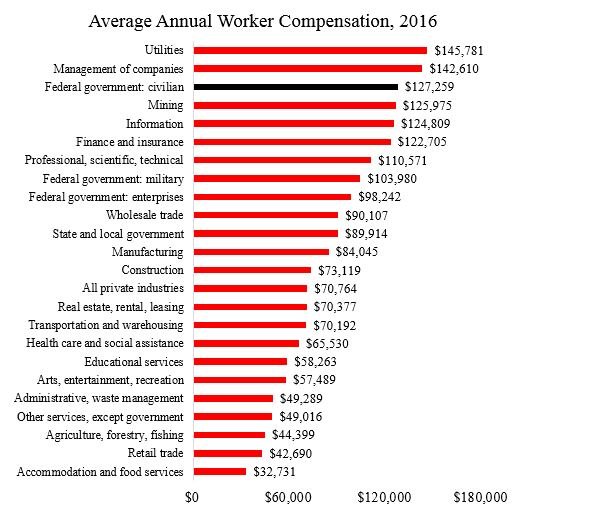
Edwards acknowledged pay disparities based on experience and education. Again according to the BEA data, the average annual federal civilian employee compensation sits third on a list of 24 major industries. Only employees in utilities and the “management of companies” earn more per year than federal workers, Edwards said.
But Edwards did not, for example, specifically compare whether federal IT professionals earned more or less than their counterparts in IT or cybersecurity positions in the private sector.
Other think tanks have also looked at this topic, often choosing to include different measures or use slightly different data to reach their conclusions. The Heritage Foundation, for example, found federal pay 22 percent higher than private sector wages, according to a 2016 report. The American Enterprise Institute in 2011 said federal pay is about 14 percent higher, on average, than private sector wages.
Edwards acknowledged the often controversial study from the Federal Salary Council, which he said is based on “complex and nontransparent calculations.”
The Bureau of Labor Statistics and Office of Personnel Management annually compare federal pay with the private sector. Federal employees, on average, earn about 34.07 percent less than their counterparts in the private sector, according to their latest calculation. BLS and OPM use data from the National Compensation Survey and the Occupational Employment Statistics program to calculate their version of the pay gap between the public and private sectors. This calculation only compares pay, not the total compensation and benefits that workers receive.
The Federal Salary Council uses this comparison to calculate locality pay rates for federal employees in various locations across the country. Congress passed a law in the 1990s that was designed to eliminate the pay gap — using Salary Council calculations — between public and private sector workers, but lawmakers have never set aside enough funding to do that.
A partial freeze on wages, as President Barack Obama authorized between 2011 and 2013, along with significant changes to the federal retirement system, would help lower the disparity between public and private sector compensation, Edwards said.
Specifically, Congress should end the defined benefit pension plan for federal employees and privatize some public sector jobs, including postal workers, air traffic controllers and Amtrak employees.
“Federal pay should be reasonable, and we need competent people in federal jobs, assuming that the jobs are useful ones,” Edwards said. “But the government should not be one of the highest paid industries in the nation. Indeed, an advantage of reducing federal pay would be to encourage greater turnover in the static federal workforce. That would help more young people enter government and bring in fresh ideas.”