A post submitted by CGI member ScienceTruth.
***************************
Yes, There Is Electricity in Space !
But it must have Matter Present for its Transmissibility
The Winnemucca Institute for Advanced Studies, Presents:
The Dynamical Forces in the Astrophysical Plasmas surrounding the Central Object in Stellar Glow-Mode Z-Pinch Nebulae (SGZ), and in their adjacent Interstellar Medium (ISM),
as caused and shaped by Electricity in Space, and the subsequent attendant collateral dynamic, that of Magnetic Fields !!
( a former in-person Presentation, thus the 'speaking voice' style of language )
I'll be your 'spirit guide' on our journey through our local quadrant of the galaxy, as we survey these amazingly beautiful SGZ objects, formerly called Planetary Nebulae.
M2-9
Planetary Nebula is the historic name from 175 years ago for these objects, but it is woefully incorrect in modern scientific terms, they really are a Stellar Glow-Mode Z-Pinch Nebula, or SGZ for short. Early astronomers saw vaguely round, faintly glowing objects, which they assumed would eventually condense into a planet; or because they weren't shining like a star, and were glowing more like a planet, in the lower resolution of detail telescopes of those days, they called them a Planetary Nebula.
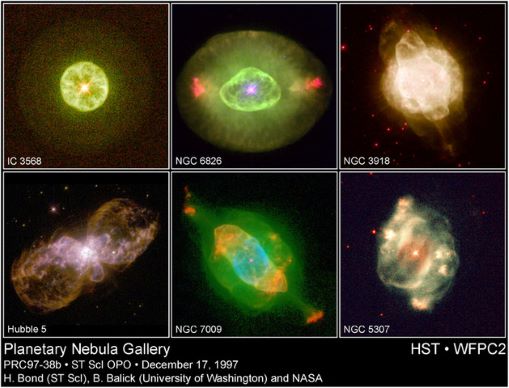
PNe 6 images
I would like to take five minutes, to give a short introduction about where we are today, by quickly covering the last 120 years of how Mainstream Consensus Science has led us seriously astray from what is REAL, and off into a never-never-land of fantasy and illusion, like the Big Bang, Black Holes, Neutron Stars, Dark Matter and Dark Energy.
Yes, this is a right and a left to the jaw, and 3 punches to the gut of Mainstream Astrophysics !!! one of which landed on Mainstream's solar plexus ! leaving Mainstream 'breathless' !!, for a short interim while we explore some new ideas ! So, please leave your doubts, fears, and questions aside until you finish reading all of this, but please DO make notes along the way !! as all questions will be addressed, as best as possible, in subsequent hours and days, and who knows, we might learn something from You !! or be prompted to look in a direction not considered before !! so your astute participation in this journey and excursion is very, very valuable !!! So hang on tight ! as some of this will likely challenge your long-held views and ideas !!
We are today standing on the leading edge of the most turbulent revolution in Physics, Astrophysics, and Cosmology, since the time of Copernicus, Galileo, and their heliocentric solar system model, because the Mainstream Consensus Science Community has adamantly denied for the last 120 years, the highly Electrical Nature of Matter and its dynamical electrical actions in outer space and in space plasmas. Today, the Independent Science Community is actively investigating electromagnetic influences within our solar system, on; comets, planets, solar ejected plasmas, and even on interstellar plasmas and nearby large objects and structures, and their predictions are being confirmed every year by our new space-based telescopes and space probes !
Yes, these are exciting times !!! I do find it most intriguing that Mother Nature, in her infinite wisdom, blesses us with the ability to witness the amazing beauty she creates, and SGZ's are a prime example of that Beauty, in how Energy interacts with Matter and on a large scale ! A scale of 1 to 3 light years in size !
What do I, and Mel Atcheson who coined the term SGZ, mean by a Stellar Glow-Mode Z-Pinch Nebula. Stellar; as in star, meaning these are star-sized central objects. Glow-Mode; when an electric current runs thru a plasma, the plasma can be in 3 modes, Dark Mode, Glow Mode, or Arc Mode. Dark Mode is where the electric current is at a low level and the outer electrons of the atoms are not energized enough so as to radiate their 'excess energy' by emitting a photon of visible-light energy, but they could be emitting in the radiowave, microwave, or infrared wavelengths. Glow Mode is when the electric current is sufficient to energize the outer electrons to emit photons of visible-light or ultraviolet-light energy. Arc Mode is where the current flow is so strong the plasma looks like the atmosphere of a star, or the electric arc of an arc welder when welding metals together, the electrons are emitting extreme photon energy radiations into the far-ultraviolet, x-ray and gamma ray spectrums.
The Z-Pinch occurs when there is a sufficient electric current surge to cause the magnetic field surrounding the electric current's path thru the plasma, to quickly increase resulting in a constriction of the plasma into a very tight and narrow pathway for a short distance. This is because a subsequent corresponding magnetic field will arise in proportional conjunction to the current flow. This has inevitably led to experimenters in their garage building Z-Pinch magnetic field soda can crunchers ! However, Mainstream still considers M2-9 to be a kinetic fluid-dynamic phenomena, I assure you it isn't, it’s an electric-plasma Z-Pinch phenomena.

Irving Langmuir
In 1926 Irving Langmuir (1881-1957) first published the term 'plasma' for ionized atoms. This followed his decade long investigations of the electron configuration in atoms, his research into longer lasting light bulbs, and experiments with electrified plasmas in glass tubes. He called it 'plasma' after blood plasma, for two reasons; they both transport particles, and the Greek word plasma means 'to mold' which plasma does as it fills all the space between the electric double layer sheaths that surrounded it during his experiments in glass tubes.
Ionized plasma also exhibits 'life-like' qualities in that it is quite unpredictable in its behavior, and that it often generates an electric double-layer surrounding itself which insulates and protects itself against a hostile environment that would otherwise destabilize this plasma 'cell' and cause its demise. We now know that each of the cells in our own body uses a small electric double-layer to surround itself and personally protect itself, so as to maintain a secure autonomy within the greater environment of our general body.

Willard Harrison Bennett
In 1934 Willard H. Bennett (1903-1987)did plasma experiments wherein he ran an electric current thru a plasma gas in a glass tube, and observed how the magnetic field surrounding the electric current would cause a rapid constriction of the plasma during a rapid surge in the electric current flow. As the glass tube was usually mounted in a vertical position, it became termed a Z-Pinch after the x-y-z coordinate system for the 3 spatial axes.
My purpose in choosing outer space SGZs is that they represent our best laboratory for the study of Energy interacting with Matter, and on a large scale ! SGZs have a very high level of energy intensity, much more than a regular star, but not as much as a supernova or an active galactic nucleus. But even more importantly, SGZs have large surrounding Field Structures, electric field and magnetic field structures, and these fields organize the glowing plasmas and show us exactly how Energy is interacting with Matter, and I suspect this will lead us to great new understandings about the true nature of Matter, Energy, Fields, and how to make the best use of the principles in physics we do not yet fully understand. All of this makes SGZs, among all of the objects that are out there, our best candidates for study and learning !
SGZs range between 650 and 10,000 light years away. A light year is how far light will travel in a year. And what is the velocity of light, it's about 186,000 miles per second, or 300,000 kilometers per second. That makes it almost 6 Trillion miles to a light year (5.866), and with SGZs mostly between 1,000 and 8,000 light years away, that's quite a distance, but in galactic terms, SGZs are right in our backyard ! Our galaxy is about 100,000 light years in diameter, and we are about 26,000 light years from the center, a little more than half-way out from the center to the outer rim, in our quadrant of the Galaxy that is.
Here is how SGZs have the advantage. Our Sun is about 8 minutes away, but it's a normal, quiet star. SGZs mostly range from 1000 to 8000 years away, and are extremely intense centers of activity. Our somewhat active galactic center is 26,000 years away, but is highly obscured by dust and other material and is nearly impossible to see in the visible light range. Super Nova (SN) 1987a was in the Large Magellanic Cloud, about 135,000 years away. The next closest large galaxy is Andromeda, about 2 or 3 million years distant. The closest Active Galactic Nucleus (AGN), in M87, is 53 million years away !
SGZs are very intense, they are relatively close, and we have a very clear view of them !
Yes, our Sun is our closest intense object for study, and we do study it, and at a distance of only 107 diameters of the Sun, from the Sun, we are close ! Our solar system is 12 light-hours in diameter. Pluto's orbit, 4 Billion miles in radius, makes a circle 8 Billion miles across, but light takes only 12 hours to traverse that total distance. Compared to our solar system, SGZs have enormous field structures, that range from 1 to 3 light years is size, and they are filled with glowing plasmas ! Half-a-day compared to about 2 years, that's a big difference in size between our Solar System and an average SGZ.
Our Milky Way's galactic central region is 26,000 years away, and is extremely obscured by dust and particulate material, whereas all SGZs are easily, and clearly observable, and much closer, only 1000 to 8000 years away ! All this makes SGZs clearly the winner ! And why they are the closest and best laboratory for understanding how the primary phenomena of Energy in three of its Manifestations; the Radiative State, the Electrical State and the Field State, interacts with its fourth primary State, that of Matter, and all in the presence of a Gravity field and subject to Inertia/Momentum resistances.
Next Saturday we'll look closely at some SGZs to see what they are showing us, formulate some questions we might ask, and see what we can learn from them !
As an extra for now, here is background on some of the instruments that were developed over the last 500 years.
As the telescope is an extremely important invention for all of these "outer space investigative endeavors" a brief history of the telescope is definitely in order !! Hans Lippershey, an eyeglass maker in the Netherlands applied for a Patent in 1608, but he didn't get the Patent. News spread and in 1609 Galileo used this design of a convex objective lens and a concave eyepiece, and he used it for astronomy. In 1611 Johannes Kepler described how a telescope could be made with a convex objective lens and a convex eyepiece lens. By 1655 Christiaan Huygens and others were building powerful Kepler style telescopes with compound eyepieces.
Isaac Newton built the first reflector telescope in 1668 with a design incorporating a small flat diagonal mirror to reflect the light to an eyepiece mounted on the side of the telescope tube. Laurent Cassegrain in 1672 described the design of a reflector with a small convex secondary mirror to reflect light back through a central hole in the main mirror, thus shortening the total length of the telescope's tube, while maintaining or even lengthening the total 'focal length' of the equipment. [1]
The achromatic lens, which greatly reduced color aberrations in objective lenses and allowed for shorter and more functional telescopes, first appeared in a 1733 telescope made by Chester Moore Hall, who did not publicize it. John Dollond learned of Hall's invention[2][3] and using it began producing telescopes in commercial quantities, starting in 1758.
Important developments in reflecting telescopes were John Hadley's production of larger paraboloidal mirrors in 1721; the process of silvering glass mirrors introduced by Léon Foucault in 1857; [4] and the adoption of long-lasting aluminized coatings on reflector mirrors in 1932.[5] The Ritchey-Chretien variant of Cassegrain reflector was invented around 1910, but not widely adopted until after 1950; many modern telescopes including the Hubble Space Telescope use this design, which gives a wider field of view than a classic Cassegrain.
During the period 1850–1900, reflectors suffered from problems with speculum metal mirrors, and a considerable number of "Great Refractors" were built from 60 cm to 1 metre aperture, culminating in the Yerkes Observatory refractor in 1897; however, starting from the early 1900s a series of ever-larger reflectors with glass mirrors were built, including the Mount Wilson 60-inch (1.5 metre), the 100-inch (2.5 metre) Hooker Telescope (1917) and the 200-inch (5 metre) Hale Telescope on Mt. Palomar (1948); essentially all major research telescopes since 1900 have been reflectors. A number of 4-metre class (160 inch) telescopes were built on superior higher altitude sites including Hawaii and the Chilean desert in the 1975–1985 era. The development of the computer-controlled alt-azimuth mount in the 1970s and active optics in the 1980s enabled a new generation of even larger telescopes, starting with the 10-metre (400 inch) Keck telescopes in 1993/1996, and a number of 8-metre telescopes including the ESO Very Large Telescope, Gemini Observatory and Subaru Telescope. [1]
References:
[1] https://en.wikipedia.org/wiki/History_of_the_telescope
[2] Lovell, D. J.; 'Optical anecdotes', pp.40-41
[3] Wilson, Ray N.; 'Reflecting Telescope Optics: Basic design theory and its historical development', p.14
[4] "Inventor Biographies – Jean-Bernard-Léon Foucault Biography (1819–1868)". madehow.com. Retrieved 2013-08-01
[5] "Bakich sample pages Chapter 2" (PDF). p. 3. Retrieved 2013-08-01. "John Donavan Strong, a young physicist at the California Institute of Technology, was one of the first to coat a mirror with aluminum. He did it by thermal vacuum evaporation. The first mirror he aluminized, in 1932, is the earliest known example of a telescope mirror coated by this technique."