Your New Midi Desk-Workbench Homebuilt Under $75! How to scribe & fit that lower space-saver shelf - Many photos & lumber list
Notice: Be careful when using tools and power tools. Always wear eye, hearing, and breathing protection. Safety goggles, hearing muffs, and dust masks are recommended. Use work gloves as necessary. This editor is not responsible for your safe or careless use of tools and/or materials and is not held liable for the results or outcome of any recommendations for this project. This table, desk-workbench will perform correctly and safely when properly constructed with good fasteners and workmanlike fit and finish. Use your sandpaper, rasp, etc., finishing tools to ensure there are no loose splinters which could contact users of the product.
If you do not feel comfortable operating tools or cannot operate tools you might have the store cut the boards for you as they sometimes do. Also you might get some helper(s) to assist you. Persons with any amount of beginning carpentry might be able to construct this simple workbench in a day or two or within a week. Do a step or two a day as time permits and you should have your desk-workbench in a few days.
______________________________
Did you ever need to do a hobby, or sewing, or crafts, or home repair project and needed at least a small, sturdy workbench or table to work on? Of course you have....we've all been there, and, some of us have had to use the top of a sawhorse or ordinary table to work on. My store-bought sawhorse is only 5 & 1/2 inches in width and the screws under it kept coming loose from the vibration of hammering, etc.. Also it had a tendency to collapse if the legs folded, so it was more of an annoyance than a helpful thing.
Here's your chance to get your own custom sized medium (midi) desk-workbench with a lower space-saver shelf for under $75 dollars. In fact it may be around fifty or so dollars if you have any nails and/or screws on hand and any scrap lumber which may be possible to use for some of the desk-workbench parts.
Nowadays space is at a premium for lots of folks, so, there may be a tendency to give up on those dreams of hobby-crafting like jewelry making, for example, but, not to worry! A medium sized desk-workbench which can sit in a corner or alongside a bed or in a nook in the den, etc. might be just the ticket for those who can't afford a nice office or shop, and, those dreams and aspirations to create some custom jewelry, soldering, do some creative embroidery, some painting, sculpting, floral arranging, or potting of plants, etc., may come true after all.
Instead of an outdoor workbench, consider an indoor one which is still sturdy and strong and serviceable, but is a bit smaller than a traditional 5 or 6 or 8 foot long workbench. Consider building yourself a smaller, 22" x 48" handier sized desk type of workbench which, having a lower shelf, can even be used as a leg and foot warmer. Such a handy desk-workbench can support hundreds of pounds of weight and can even be used for computers and doing editing and writing. The lower shelf can easily support heavy boxes of computer paper and more.
1.
Decide on how long and how wide your own personal desk-workbench should be. The desk-workbench in this example is 22" wide x 48" long.
2.
Next, decide on the height.
What might be considered average table heights might be from around 28" on up. A few desks, etc. might be a bit shorter in height. One way to consider what you will need is to determine whether you will use the desk more when standing or more when sitting. For example, an active floral arranger might need to stand most of the time, striding and moving about and transferring arrangements to and from the table desk-workbench so might prefer a nice high table nearly at waist height. This would prevent unnecessary stooping and bending and allow plenty of room beneath the tabletop for shelf space. When sitting, consider the kind of chair or stool you will sit in and measure how many inches from the floor it is to the tops of your knees when sitting with thighs fairly parallel to the floor. You might find that somewhere just short of 2 feet to somewhere just over 2 feet is the measurement. It would probably be wise to allow several inches of space above the knees to the bottom of the 2" x 4" ( 1 & 1/2" x 3 & 1/2" actual size) side rail in the sitting position. That means there would be some room above your knees before bumping into the lowest part ( 3 & 1/2" high side rail) of the table-desktop. Perhaps four inches above knees would be plenty for most folks, etc.. Use your judgement on the height measurement.
Photo
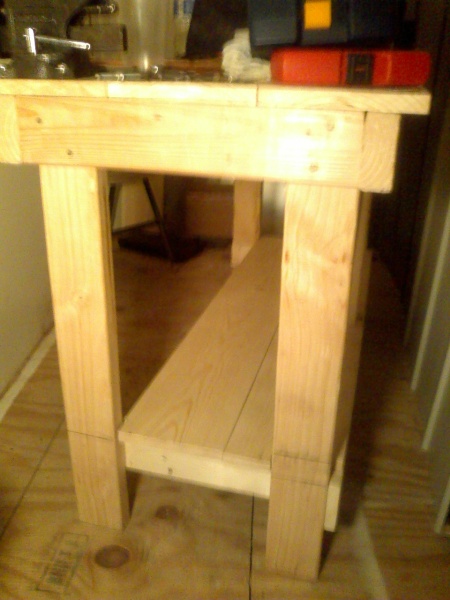
You will measure and cut all four legs for the workbench to the desired height of the tabletop minus the 3/4" for the top boards. You can make the workbench higher than the minimum suggested for leg room, but if you plan to sit at the workbench it would be smart to observe that minimum height suggestion. Therefore, if knees are at 22" from floor while sitting in the chair to be used at workbench you might say the minimum height for the workbench would be 22" + 4" + 3 & 1/2" plus 3/4" = 30 & 1/4" minimum height. If that tabletop seems too high to comfortably work on while in sitting positions you can reduce the height by bringing the top rail down closer to the knees, remembering you are losing a bit of room above the knees.
A nice desk-workbench height for an approximately 6' tall person might be about 30". Sitting in an ordinary card-table type of chair this puts the knees at about 22", and, with four inches above that the rail 2"x4" supports start at 26" high, yielding a gross height of 30 & 1/4". It has an offset tabletop which allows for the placement of a vice on one end where there is no lip overhang. This allows stock to be worked on to hang off the side down toward the floor without obstruction and allows for the vice lag bolts to have 2" x 4" stock for support. The offset feature is yours if you choose it and is created by simply placing the top 48" long 1" x 8" boards flush on the vice end and overhung 1" on the other end when nailing them on. The overhang-lip on the end and sides is ideal for attaching or clipping a lamp arm to when equipping the desk-workbench with good lighting. The lips can also be drilled and cords can be run through them or power strip electrical stations can be easily screwed to them for battery charging stations for electronics, etc..
Use a lumber pencil, aka lumber crayon to make the marks on the lumber for cutting and fitting and scribing. If you don't have one you might use a no. 2 pencil in place of a lumber pencil.
12 Main frame members & sizes
4 main table legs = 2" x 4" x 29 & 1/2" each or your choice
2 end top rails = 2" x 4" x 17" each
2 side rails = 2" x 4" x 47" each
1 lower side rail = 1" x 4" x 44" (can also make this from 1" x 6" stock)
2 end bottom rails = 1" x 6" x 17" each - 2 bottom end rails cut from left over 4' x 1" x 8" piece of top board.(These can be 1" x 4" stock if you nail any paneling on the ends of the desk-workbench which will provide the racking strength.
1 lower rung = 2" x 4" x 39 & 1/2"
8 Minor frame braces & bridging & sizes ( you may have scrap wood on hand to cut these from)
1 vertical hanger stile = 1" x 4" x 24 & 1/2" (can also be wider stock as a 1" x 6", etc.)
2 center rails = 2" x 2" x 17" each
2 rear diagonal braces = 2" x 2" x approximately 17" each
2 front diagonal braces = 2" x 4" x about 8-9 inches each. (use scrap blocks from ends boards and forty-fived each end)
1 short rung bridge = 2" x 4" x approximately 9" (just a piece of 2x4 block, can be scrap of wood)
5 Top & lower shelf boards & sizes
3 top boards = 1" x 8" x 48" no. 2 or better or surfaced lumber with few small knots.
2 lower shelf boards = 1" x 8" x 48" no. 2 or better or surfaced lumber with few small knots.
Assembly
1 - 2" x 4" x 8 foot board will make 2 legs and a top rail, therefore, you only need 2 - 8' x 2" x 4" boards for the legs and top rails. Select fairly straight lumber with no major bows, crooks, warps or knots, etc..
Cut 2 - 29 & 1/2" pcs. and one 17" piece from one board and repeat it again on the second 2" x 4" board. Make sure the ends are square and not cracked or split. Rasp or sand them to make them smooth and square on the end, if necessary. You will have used about 76" of each board plus any waste that is cut out for defects. Use the remainder of each board to make the front diagonal braces.
Using at least 12 or 16 penny nails, nail the 17" top 2x4 rails to the top ends of the 29 & 1/2" legs on the square. That means nail it across the top of the uprights at a right angle as in the above photo. Place the legs at the ends of the rail. Use your carpenter's framing square to assure you are square here. Use at least 2 of these large nails for each top joint.
Cut and fasten the bottom rails
Cut 2 - 17" pcs of 1" x 6" from a fairly straight 1" x 6" board for bottom end rails or just use the remainder of half of one of the 1" x 8" x 8 foot boards.
Using 8 penny box or cement coated sinkers (at least 6 penny) nail the bottom 1" x 6" end rails to the bottom area of the upright legs ON THE OPPOSITE SIDE FROM THE TOP RAILS at about 8-12 inches from the bottom at a right angle, also, to the legs. Nail at least 2 nails top and 2 nails bottom OF EACH leg OF THE RAIL to provide plenty of racking strength. That means at least 8 nails and it's good to nail another one in the center of this nail pattern for a trussed effect. That's ten nails per frame. This will be the height above your feet where the bottom shelf is placed. Use your own preference for this height according to what you will be doing; reading, working, standing or sitting, etc.. Make both ends the same height for nailing these bottom end rails on so your shelf will sit level. You are nailing the bottom end rails to the inside and the top rails to the outside of the ends as you sit facing the desk.
Nail on the side rails
Photo
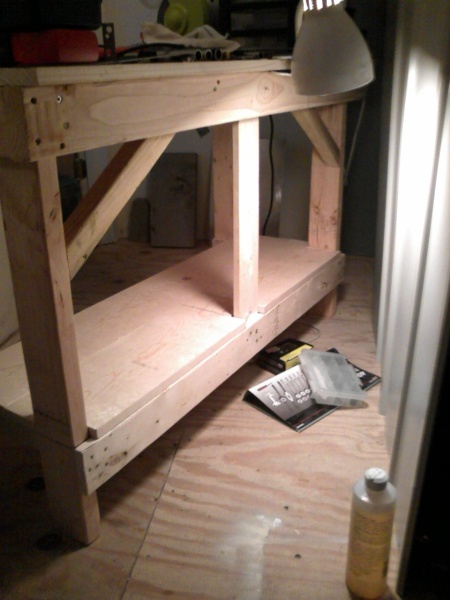
Now that you have the ends made, you need to nail on the side rail 2x4's at the tops of the ends as in the above photo, the long board at the top under the side of desktop. These must not be warped, that is, not twisted at all in the least bit. You do not want your desk-workbench to wobble, but you must keep these particular framing members straight, so, when you select your lumber you'll want to make sure these longer 2x4's are straight. If this board has a very slight crook in it you can place it with the crown up after cutting it and make sure the other side is also crown up - high side up. It should not be crooked to any noticeable amount.
Cut the two side rails from the straight 2x4x8' at 47" each. Make sure the ends are square and not cracked or split. Rasp or sand them to make them smooth and square on the end, if necessary.
Using 12 or 16 penny box or cement coated nails, nail the side rails on each side while holding the ends at a perfect right angle, using carpenter's framing square again. You might prefer to lay the table frame on the side onto a flat, level surface in order to do this step. If you lay it down like that you might insert a small 2" x 4" block under each leg bottom to make the bottom ends even with the top side rails and not have the bottoms of the legs flopping around unevenly while nailing and fastening. It is helpful to have a helper to hold the stock while nailing it. You may, instead, also use long woodscrews for this instead of adding them as a finish step. They should be at least 2 & 1/2 - 3 inches long. Remember to drill pilot holes for the screws. If this desk-workbench is to be used, say for study by students, office workers, etc., eventually the nails should be set below the surface of the wood and screws should be countersunk also below the wood surface and all heads filled, puttied, sanded and sealed. It would be a good idea to do that, anyway, to prevent florists, hobbyists, etc. from scratching themselves and clothing on nail heads, screw heads or splinters.
Cut a lower side rail 1" x 4" x 44" (can also make this from 1" x 6" stock) and nail on the outside of the rear lower legs flush and level with the lower end rails. Nail it across the legs with 8d box nails or cement coated nails and to the end rails with 6d box nails. Later the lower rung will complete the lower longitudinal framing connections, leaving the front rather open for knee, foot, and leg room.
After adding the side rails which join the ends you have the basics of the workbench and you need to brace it and add the top and lower shelf boards.
Add center top rails
Here the table is pictured partially upside down showing a cross rail nailed and butted into the long side rail. A diagonal brace is notched and fastened to it.
Photo
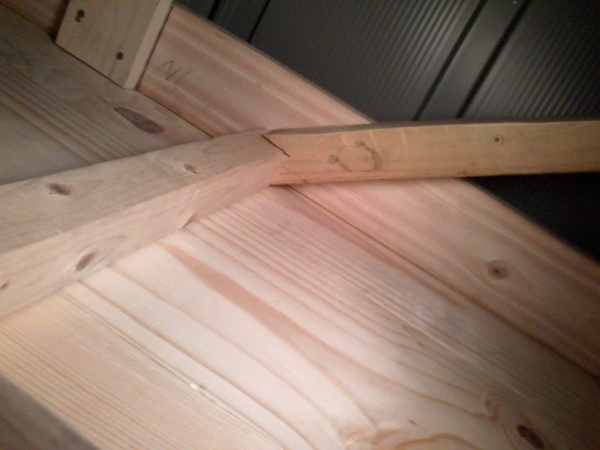
Nail 2 center cross rails at right angles and flush to the top level between side rails to bridge the side rails together and to provide additional support for the center of the top 1" boards. Space them equally apart from ends and each other. On my table it leaves only about 13" or so between supports for the top boards to nail to, a very sturdy arrangement.
At this point check the square across the table top before adding bracing and top boards. Looking down on top of the frame with the table in an upright position measure across the diagonals of corner to corner across the table top. The diagonals should be exactly the same. The diagonals form the hypotenuse of a right triangle, so if the tabletop is a rectangle you should have equal diagonals. Rack the carcase into line as needed to square it and nail a temporary brace across to secure it for bracing to keep it square.
Add diagonal bracing from legs to side rails.
Photo - view of a diagonal brace looking from the outside rear of desk-workbench. Keep the joints as tight and accurate as possible. Here it is fastened to the left leg at lower end and goes up inside the top side rail to hook into the cross rail by notching the brace.
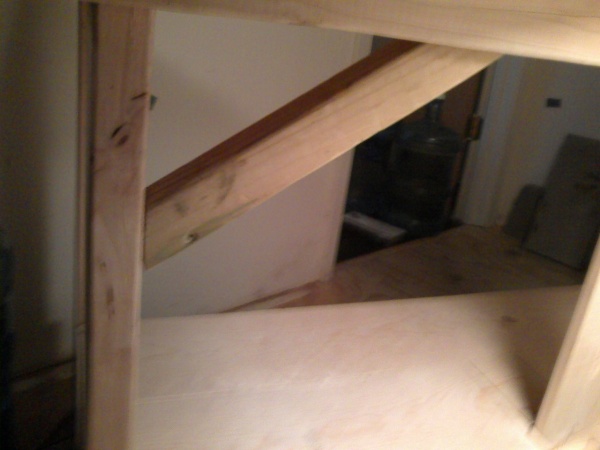
It only takes one 2" x 2" x 8' to cut 2 center 17" cross rails and 2 diagonal 17" braces.
Fit bridging by first ensuring the legs are at right angle to the top surface of table and are plumb, straight up when table is standing upright. Hold and mark 2" x 2" stock against center cross rail on one end and down to rear leg at an approximate 45 degree angle. It doesn't have to be perfect 45, but your marks must be accurate according to the cut and where you nail the brace. It is best to notch the upper end of the brace where it meets the bottom of the center cross rail bridge piece. This ensures it will not slip. If you prefer you can temporarily brace the assembly again and turn it over upside down where you can more easily access the undercarriage of the table for adding braces.
Nail or screw 2 short 45 degree blocks inside the front at the top ends where side rails meet ends. These can be a couple of 8 or 9 inch scrap blocks of 2"x4" or 2"x6" forty-fived on ends to screw or nail into the legs and side rails. Even without my lower shelf nailed into place the table is already extremely strong without these two braces which some might feel interfere a little with leg room beneath the table. Remember to nail the top of the braces no higher than the tops of the side and end rails so the top boards will fit properly down level and flush. Nail these braces with 10 penny or larger box or cement coated nails. As described above these 2"x4" materials can also be fastened with woodscrews. Also longer deck screws can be used.
Nail on the rear center stile hanger
That bright upright board in the center which runs top to bottom of the rear in this photo is the stile hanger.
Photo
This vertical stile hanger, as I call it, is optional. It creates a trussed effect out of the rear plane of the desk-workbench similar to a roof truss found in regular buildings. This hanger is equivalent to a 'king post' in truss construction. Those familiar with truss construction will recognize the pattern. By connecting it to the bottom rail it is, in effect, the king post connection to the lower chord of the truss. The diagonal bracing completes the triangles with the 'queen posts'. This adds even more support to the lower rung by the 1 short rung bridge [2" x 4" x approximately 9"] connection between the rung and bottom side rail. What you are getting here is a bit of engineering similar to floor construction, the joist and bridging method, reinforced by roof truss principles.
On the inside of the top of the frame locate and mark the center of the top rail between the ends at about 23 & 1/2" from either end of the 47" frame. Do the same for the bottom rail and nail the 1" x 4" x 24 & 1/2" stile exactly in the center of the marks perfectly upright at right angles to the top and bottom rails on the inside of the rails.
Locate, mark and nail on the lower rung
Photo - The long 2" x 4" running lengthwise under the shelf board is the rung and butts into each lower end rail.
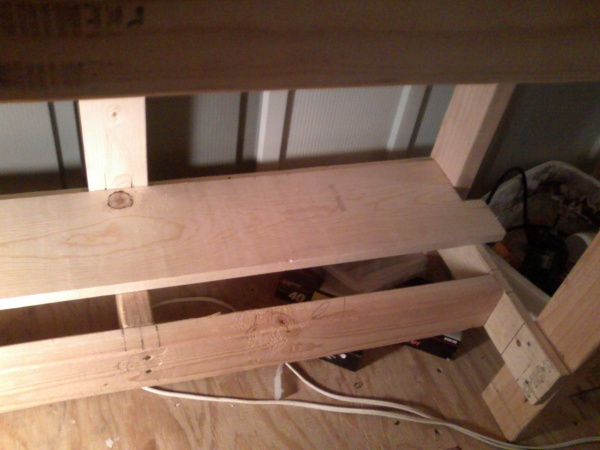
Cut a piece of 2" x 4" x 39 & 1/2" stock from a 2" x 4" board and ensure the ends are square and smooth. Rasp or sand them to make them smooth and square on the end, if necessary. Mark the top and inside of the lower end rail at 9 & 3/4" from the rear of the leg. Do this on the other end rail on the other end, also. This measurement creates where the rung is to be nailed in place and is optional according to how much space you want for foot room. Using at least 8 or 10 penny nails nail the 2" x 4" x 39 & 1/2" lower rung squarely in between the two end rail marks, on edge with the crown up, top edge flush with the top edge of the end rails, at least 2 nails in each end.
Locate, mark and nail the short rung bridge
Locate and mark the center of the top of the lower rung halfway between ends. Locate and mark on the bottom area of the stile hanger a parallel mark even with the top of the rear side rail.
If your rear lower side rail is not bowed out, the distance between the lower rung and the center stile hanger will be about 9 inches. Cut a scrap of 2" x 4" stock ensuring the ends of it are square and nail edge up, level on the marks, in between the bottom of the center stile hanger and the lower 2" x 4" rung keeping the top edge flush with the top of rung and lower side rail mark on the stile hanger. The bottom and top of the rung should be about level with the bottom and top of the lower side rail.
You now have the basics to nail on the top boards.
Select two 1" x 8" boards, one 8 feet long and the other at least 4 feet long and cut 3 - 1" x 8" x 48" pieces for top boards. Make sure this lumber is surface with as few small knots as possible and, hopefully, no large knots. It may be bowed a little bit which can be nailed or screwed down flat to the frame, but should not be noticeably twisted, cupped or warped or crooked.
Stand the frame upright and remove the temporary diagonal bracing and nail on the top boards keeping an even overhang on front and rear lips. You might want to place the boards flush with the end frame on the end where a vice goes,as mentioned earlier above. This allows chucking stocks clear down to the floor in the vice without obstructions. In that case keep the boards flush at that end or split the difference if this is not preferred. Lay the top boards in position remembering to keep the frame diagonals equal and position the center board directly in the center with outer boards securely against center board. Nail the outer board first, keeping exactly the same margin of overhang along the side rail as you nail. You can use a simple carpenter's combination square set at about 3/4" to 7/8" depending on the exact width of the 1" x 8" top board stock you bought.
1" x 8" lumber does vary from 7 & 1/8" or so to 7 & 1/4" to sometimes a full 7 & 1/2". Your frame which started at 17" ends is now 20" with the side rails having been added, each side rail measuring about 1 & 1/2" in width. Three full 7 & 1/2" wide boards equals 22 & 1/2", so added to a 20" table top would leave 1 & 1/4" lip on each side, but it is more likely your stock will measure around 7 & 1/4" which the three boards equalling a total width when put together would be around 21 & 3/4" would leave a nice 7/8" lip overhang on each side, front and rear, plenty enough to clip a desk lamp to.
Remember to position and nail one end of top board to frame while holding it to the former board. Pull any slight crooks TOWARD THE FIRST TOP BOARD to close the gap and create a tight workmanlike job. Adding the top boards provides diagonal permanent bracing for the top plane of the desk-workbench. Use at least 6 penny box or cement coated nails to nail on the top boards. 8 penny would not be too large and would provide good holding power. If you expect to have moisture and dampness on your table you should use galvanized box nails which also provide secure holding power. You can add a few 1 & 1/2" wood screws here and there between the nails, also.
Now add the lower shelf boards by 'scribing the fit'
Photo - remember to mark your work as in this photo which indicates this side of the board goes up and to the left. It matters. When you come back from cutting the scribed marks you will want to re-position the board in the same position as when you marked it.
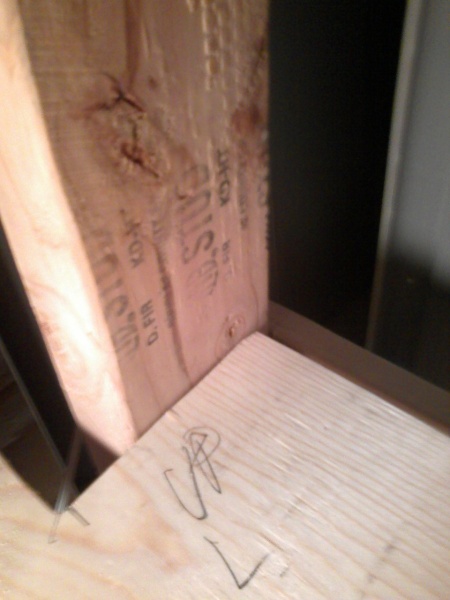
The length of the desk-workbench from outside leg to outside leg is now 44 inches, so, to make the bottom shelf boards even with the inside of the outside of the legs measure mark and cut a 1" x 8" x 8 foot board into 2 - 44 inch pieces. Again, this lumber should be pretty nice and free of major defects and large knots if you are making a nice desk-workbench.
Photo
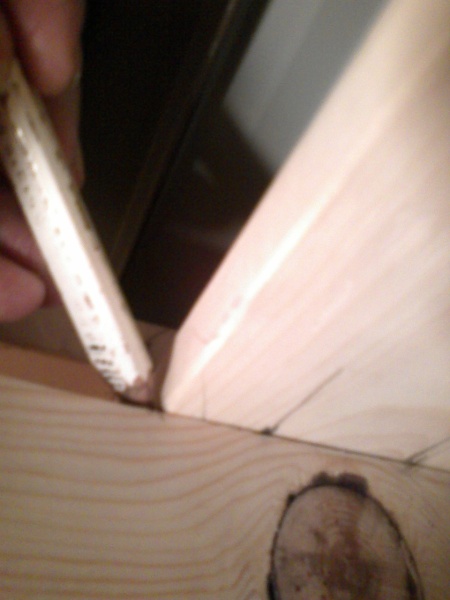
With the side of the board you wish to be up, hold the rear 44" shelf board down level on each bottom end rail and push it into the rear inside table legs on each end. Naturally, the board cannot fit all the way into place until some material is removed. While facing the table from the front and holding both ends of the shelf board firmly against the rear inside of the table legs make a mark on the rear edge of the shelf where it meets the inside of the leg. Do this on both ends of the board and extend the mark the 4 & 1/4" across the width of the shelf board towards you. This mark should be about an inch and a half from the edge, the thickness of the table end leg. Mark a line square at a right angle to the end of the board where the end of the 4 & 1/4" mark is. That approximate little 1 & 1/2" x 4 & 1/4" rectangle you drew on each end of the shelf board represents where the table leg is and must be removed, so, get your power saw, or jig saw, or hand saw and carefully cut out that block of wood on the ends.
Photo - This is what your board end should look like after removing the little end block
Now, if you were careful and cut the approximate correct amount of wood out of your shelf board the board should be able to fit against the rear stile hanger and lie flush down level on top of the short rung bridge which is attached to the rung board. You will observe that instead of fitting all the way evenly onto the rear of the lower rail the stile hanger now stops it from going further, so, mark directly onto the top of the shelf board there in the center rear surface where each side of the stile hanger meets the shelf boards.
Photo
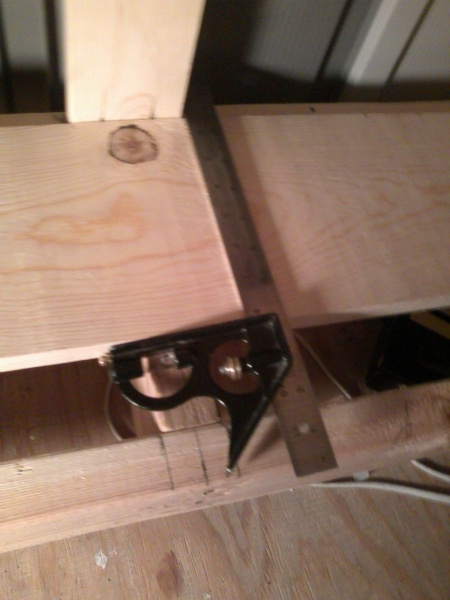
Transfer and extend these marks directly onto the top of the shelf board with your combo square or framing square.
You should see about the width of the rear vertical stile hanger now between the marks on your shelf board.
Photo
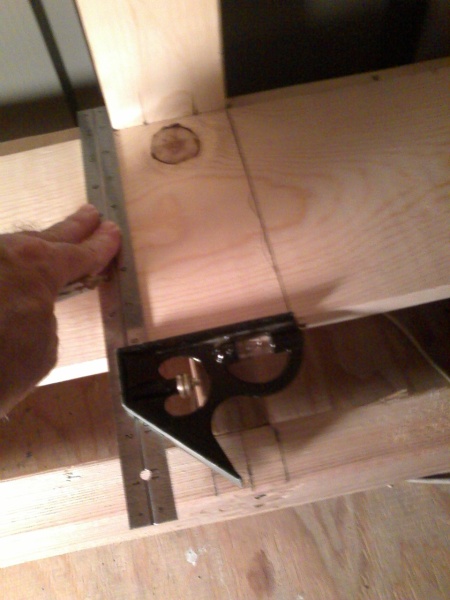
The depth of this cut will be the thickness of the stile hanger plus the thickness of the rear lower side rail. Using the dimensions of the stock suggested above, this comes to about 1 & 1/2", so, mark across the shelf board this inch and a half toward you from the rear and connect the left extended mark to the right extended mark to create another rectangular block which will now be cut out, also. Cut this out carefully and try the fit after knocking off all splinters, shavings and possible burrs, and rough edges. You want these edges square and smooth, also.
Photo - here I was able to remove most of the knot which occurred in the center of the shelf board.
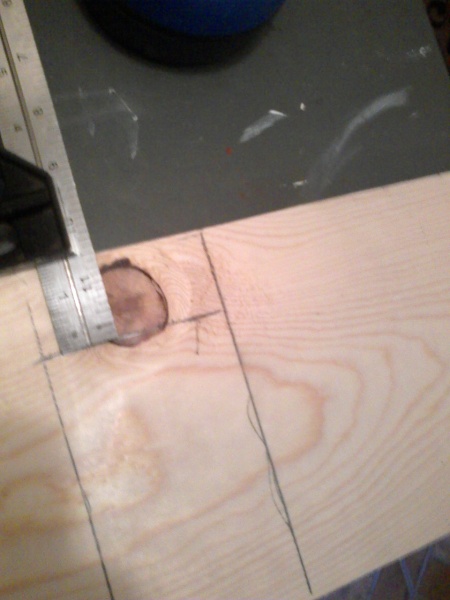
If the board does not quite fit you can remove more stock to widen the notches by using a simple wood rasp, etc., or other small sanding tools. Try not to go overboard - remove as little stock as needed until you try the fit.
Photo
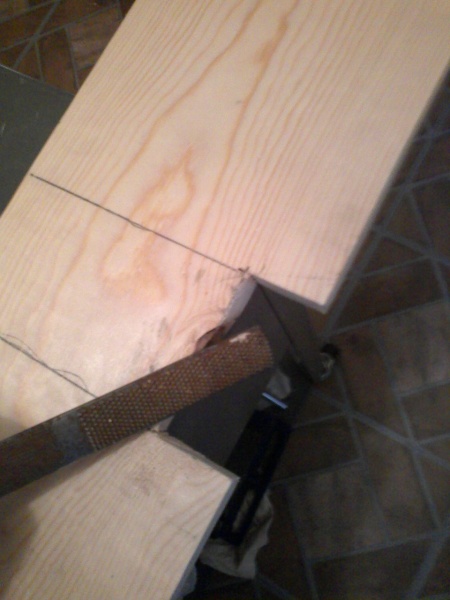
Photo - after also removing some wood on the end notch with a rasp this slight gap disappeared and the piece fits nicely. You can pull any side rail bow in toward the straight edge of the rear of this shelf board when nailing and the slightly uneven surfaces will be flush.
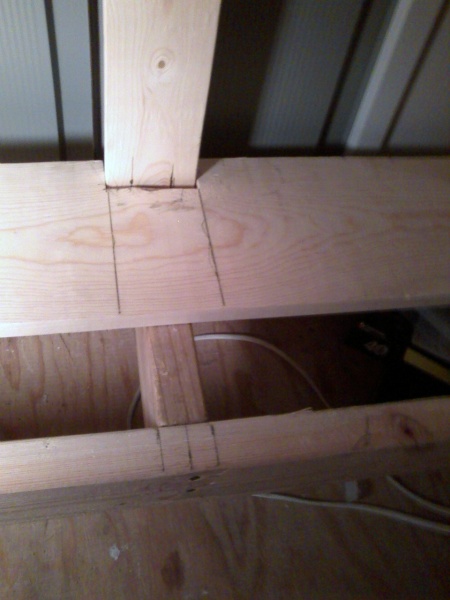
Pull the bow by aligning side rail with straight edge of shelf board
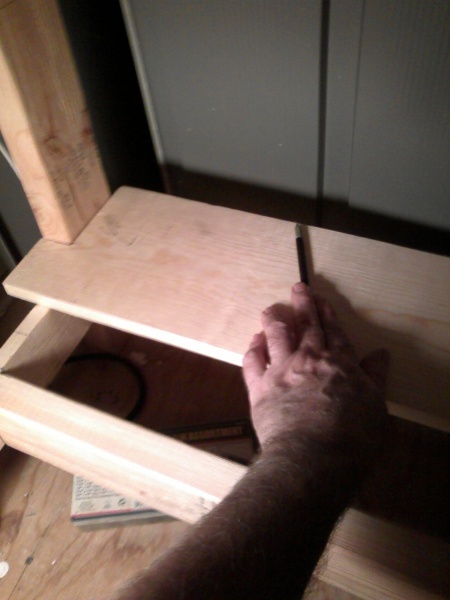
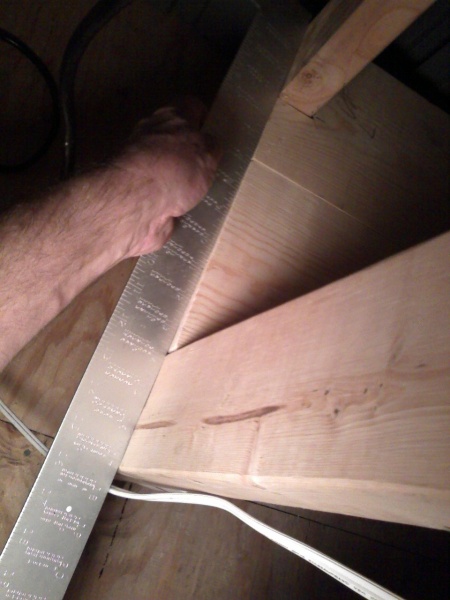
Now add the other front bottom shelf board the same way. If it does not quite clear the inside of the table legs, notch it out using the scribe and fit method above. These boards can also be nailed on with 6d nails or small woodscrews for nailing to side rail and end rails and 8d - 10d nails for nailing to rung and rung bridge. Position it exactly even with the outside of the legs and this will allow for applying attractive paneling or plywood ends to the desk-workbench and the paneling will fit just right, flush over the board ends and over the legs, etc.. At that point you could even stain or paint it!
Photo
___________________
A hutch or cabinet or series of cabinets can be added to the top of the desk-workbench and in this case consideration should be given to securing the entire piece to a wall or other secure structure to prevent toppling over as weight is added to the top area.
Nailing tip. Have a helper provide a backup to the pieces you are nailing together. A board backed up by a fairly heavy hammer will reduce excessive vibration that way. You might be able to purchase a few handfuls of each size of nails at a lumberyard that allows you to buy half a pound or any amount less and it might only cost a few dollars for nails instead of buying full boxes at home furnishing discount centers.
There, I have prepared you a table. It should serve you for many, many splendid projects for work or play. Enjoy.
Infoeditor
++++++++++++++++++++++++
Lumber list and materials recap
2" x 4" x 8' - 4 = 4 legs, 2 side rails, 2 top end rails, 1 rung, 1 bridging, 2 short braces
1" x 8" x 8' - 3 = 3 top boards, 2 lower shelf boards, 2 lower end rails, surfaced
2" x 2" x 8' - 1 = 2 center cross rails, 2 diagonal braces, common framing lumber
1" x 4" x 6' - 1 = 1 rear bottom side rail, 1 stile hanger
Note: 1 x 6 x 4 - 1 = 2 bottom end rails cut from left over 4' x 1" x 8" piece of top board.
Fasteners
6d box or cement coated nails
8d box or cement coated nails
10d-12d box or cement coated nails
16d or cement coated nails to fasten the top rails to legs and side rails to assembly.
1 & 1/2" woodscrews
2 & 1/2" - 3" woodscrews
Cost estimate
4 - Premium 2" x 4" x 8' kiln-dried studs @ 2.62 each = 10.48
3 - No. 2 common boards 1" x 8" x 8' @ 11.12 each = 33.36
1 - 2" x 2" common board @ about $2.00 ea.(?) = 2.00
1 - 1" x 4" common board @ about $2.50 ea.(?) = 2.50
Fasteners - depends on what you have on hand. $12(?)= 12.00
____________________________________________________________
Estimated subtotal before tax = $ 60.34
xxxxxxxxxxxxxxxxxxxxxxxxxxxxxxxxx
Note: This article on the midi desk-workbench is entirely original and the text and photos are not copied from any source. These basic photos are original, and although not perfect, are intended to give the reader some idea of how the workbench is constructed.
Infoeditor